The Design Technology Blog

Category: Uncategorized

  • THE UBOT: ABILITY TO SAVE LIVES

    In the movie WALL-E viewers were fascinated with the idea that  robots can  give people massages, cook for them and even clean up after them. However, due to rapid technological progression over the past years,  the fascination continues as  now a real-life WALL-E has been developed and is now accessible to humans all over the world.  At the University of Massachusetts Amherst roboticist Rod Grupen and his collaborators have worked together on developing one of the most revolutionary inventions of the 21st century- the Ubot a robot that has been created to further help people in their every day lives specifically the elderly who have difficulties carrying out their daily activities. The Ubot device could help one complete a range of activities from helping you find your glasses to calling up people in times of emergency. The Ubot has wheels that allow it to move around as well as a webcam included within its structure that helps it view objects  in order to pick them up, which is one of the famous features this invention entails. In addition to the around the clock in home assistance, the Ubot gives customers the ability to interact with people such as other family members miles and miles away. For example, someone over the internet can control the Ubot to search for their parents who are not answering their phone. If the person is not answering and it is in time of emergency the Ubot can on its own use a stethoscope  and on its own send it to a healthcare professional; or if the person is unresponsive Ubot can perform physical examination. Grupen explained how this robot can help family members care for their elderly parents even if they live in another  city,state,or even country. An experimental activity has been done and researchers are working on further developing this extraordinary invention by giving it its own ability to call 911. Therefore, the Ubot is truly a revolutionary device as it not only shows mankind’s progression in the fields of technology through the creation of the robot, but also it serves as a solution to major problem in the US, the majority of elderly people who are in need in healthcare and support. According to Grupen, “up to seventy million people will be moving into the main frame eldercare institutions we have to figure out different ways of doing eldercare in a distributed and more efficient fashion.” Therefore, a device like uBot may allow people to stay in their homes longer but still be cared for according to their needs, he says.


    Sources:

    http://www.sciencentral.com/articles/view.php3?type=article&article_id=218393123


  • DiGORO

    DiGORO is known as the ‘Learning Robot’ as it is able to remember actions that have been shown to it several times by humans then reciprocate them itself. For instance, if a person demonstrates to DiGORO how to place a ball in a bucket it will then be able to repeat the action. What is remarkable though is that it is able to reciprocate the action of putting the ball in the bucket with an unknown object. By imitating the actions of the human, DiGORO is able to learn the action and repeat it on command at another period in time. To do this, DiGORO must be told what each item is, for example you hold up a bottle and say ‘DiGORO this is a bottle.’ If you repeat this action with a bucket you will then be able to instruct DiGORO to place the bottle in the bucket.

    DiGORO is also capable of remembering people’s faces and voices simultaneously by identifying patterns of the person’s face and recognizing their colours and shapes which can prove useful for people suffering from senile dementia.

    DiGORO has a number of other useful abilities.  If words are not in its database it is able to extract them from the person’s speech and convert the word to it’s own voice. Also DiGORO can generate maps and estimate it’s location, even in places it had not been before so that it is incapable of getting lost.

    Based on the information it remembers, DiGORO can take action autonomously.  It is capable of handling tasks freely and make decisions on its own accord.

    With an increase in numbers of elderly people it has become a primary need to provide more carers and staff to care for them in their old age. When elderly people lose their ability to maneuver around with ease and perform simple tasks they begin to become reliant on other people. DiGORO provides a solution to this problem as after it has been programmed it is capable to performing tasks such as opening cans or turning the lights on which would have required a great deal of  effort from the elderly person. Although, one problem that can be foreseen with the use of robots to care for the elderly is the loss of human contact. With no human beings caring for them the elderly person will come to rely on the robot for company which raises a number of questions about the ethical implications of such a thing.

  • Robotic Painting Automation

    Robotic automation has always been the key way to develop production and the industrial civilization. We use robotics in many fields of the industry, from the most complex procedures to the easiest. One simple step that takes place in the production of many products is the painting and coating stage. As simple as it might be, it is a stage that needs speed and accuracy and needs to be dealt with care since it controls the products aesthetics. The industrial painting robot does its job with high quality once programmed well, without causing any drips, oversprays, or inconsistincies in general. The machine allows faster production painting and coating with conservation of paint to up to 15-30%. With the benefit of saving workers that are more vulnerable to VOC’s and other hazardous materials in the paint, the painting robots are perfect for the industry

    .

    http://www.robots.com/applications/painting-automation/25

  • Robotics for Medical Purposes

    The use of robot’s to aid mankind has endless possibilities. Robotics can be used in many areas including medical purposes. One area where robot’s can help is medical procedures that require high precision. Operations are done by expert’s that are skilled at what they do but people can only be so accurate. Also these skilled people might not always be available. If a robot can be built that can make operations on people it will greatly aid our society. Robot’s will not only make operations with more accuracy and precision than humans, but also they can easily be mass produced making them much more readily available for people in need than skilled medical professionals.

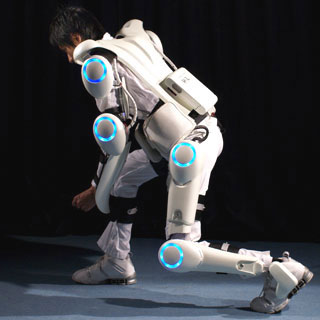
    Robot’s can also be made to physically enhance human abilities. Exoskeletons can be robotics that are in a suit/harness type thing that can be worn and will enhance muscle movement’s of the human body. In the medical view people who have multiple sclerosis might be able to use this to enhance their muscle movement’s since their condition limit’s their muscle movement. If a muscle is weak the robotics could sense the slightest force in a body part and then add power to it to make the person have a strong movement.

    Scientists Report Breakthrough in Quest For "Prosthetic Exoskeleton"


    The harness could be made to cover only some limbs or the whole body potentially letting a person who is confined to a wheelchair stand up and walk on their own leg’s again.

  • Electrolux Trilobite

    DOMESTIC ROBOT-

    The Trilobite 2.0 is a state of the art vacuum cleaner designed and developed by Swedish Electronics giant, Electrolux. The Electrolux Trilobite 2.0 is smart, flexible, and very handy. The  Electrolux Trilobite Robotic vacuum will make household chores seem like a simple task. The convenience of a robot vacuum cleaner is unheard of. This product is a new and improved version of its prototype, first introduced in 1997. This robotic vacuum has a mind of its own, as it uses advanced sonar technology to navigate throughout your home and to detect potential roadblocks as it roams. Homeowners can create virtual boundaries by laying special magnetic strips, although a new infrared stair sensor has been built in, to detect stairs and keep the Trilobite from taking a spill – all without the need for special strips. The robotic cleaner has four sophisticated motors that operate each wheel, the brush, and the vacuum itself. The system is so advanced that the Trilobite has the ability to find its own way back to the charger. Never will you need to charge your vacuum, as it will return to its station to charge automatically once it has cleaned for a 60 minute period, and it requires no bags that need to be replaced.

    Its three cleaning programs include normal, quick, and spot. During a normal cleaning cycle, Trilobite covers along walls and all open areas, then calculates the period of time needed for independent cleaning. The quick cycle skips the wall phase and goes directly to the independent cleaning phase, while the spot cycle cleans a single area of approximately 10 sq. ft. twice. This robotic vacuum is truly a handy device that can drastically reduce your cleaning time for just $1,800.

    Although this vacuum cleaner may see pointless to some, others might be in dire need of such a device. I believe it’s an outstanding leap into our future, as more and more devices are becoming robotic. This vacuum cleaner can help people who simply don’t have time to vacuum themselves, or those who are fascinated by technology (technopiles). 
    I believe that as our technology advances, it won’t come as a surprise if people widely use domestic robots such as this vacuum cleaner. 

    robotic-vacuum-cleaner-electrolux-trilobite.jpg  

                           Orange Version                                                                                                   Silver Version

    Links:

    http://www.electrolux.com/

    http://www.appliancist.com/vacuum_cleaners/electrolux-trilobite-robotic-vacuum.html

  • Scientific Robot: Adam

    ROBOT

    According to the Princeton Dictionary a robot is “a machine capable of carrying out a complex series of actions automatically, esp. one programmable by a computer”

    Ross King http://news.nationalgeographic.com/news/bigphotos/79820742.html

    ADAM

    More recently in 2010 Ross King of Aberystwyth University in Wales, UK created a new scientific robot called ADAM. It is officially the first  robot to independently gather scientific information. “Normal robots just do what you tell them, but ADAM is different, because it can hypothesize and try to solve a problem itself,” King said. It is able to carry out independent experiments without human guidance. Testing the robot, King and his team gave ADAM the task of discovering more about a specific genome. After creating around 20 hypotheses and carrying out several experiments ADAM eventually identified the genes involved. King was able to verify ADAM’s results.

    ADAM & HUMANKIND

    David Waltz of the Center for Computational Learning Systems at Columbia University states that “ADAM will inspire other scientists they’ll realize they can automate more of the process than they currently have. They can explore a wider range of possibilities without doing it all by hand.” More robots like ADAM will began working with scientists to help productivity because some topics are so complex that more scientists are needed. They could assist in drug design and screening. King is currently working on a new robot scientist called EVE to help treat tropical diseases. “While robots are better at coordinating thousands of experiments,” King said, “humans are better are seeing the big picture and planning the overall experiment.”

    Sources:

    1.  http://scienceblogs.com/notrocketscience/2009/04/enter_adam_the_robot_scientist.php
    2. http://singularityhub.com/2010/03/16/adam-the-robot-scientist-makes-its-first-discovery/
    3. http://www.aber.ac.uk/en/cs/research/cb/projects/robotscientist/
    4. http://www.google.com/webhp?rlz=1C1CHNU_enEG340EG340&sourceid=chrome-instant&ix=ieb&ie=UTF-8&ion=1#hl=en&rlz=1C1CHNU_enEG340EG340&q=robot&tbs=dfn:1&tbo=u&sa=X&ei=TFlXT9fvHc_44QT-sKnGDw&ved=0CCYQkQ4&bav=on.2,or.r_gc.r_pw.r_qf.,cf.osb&fp=95e6f5d098e4da22&biw=1680&bih=959&ix=ieb&ion=1


  • Robotic cheetah ‘breaks speed record for legged robots’

    Owners of a new four legged robot have claimed to have broke the world record for the fastest robot in the world, they named their new robot the robotic cheetah. The US Defense Advanced Research Projects Agency said that the mfour legged robot reached a never seen before speed of 29 km per hour, this is considerably fast for a robot, and also the previous record was only about 26 km per hour. The main purpose of the robot project was part of efforts to develop robots designed to more effectively assist war fighters across a greater range of missions. The design of the robots are based of real animal movements, and the movements try to immitate those of fast running animals like cheetahs. The machine is designed to flex and un-flex its back to increase the length of its stride. The four-year project had a aim which was scheduled in February 2011, ultimately aims to produce a robot which can run at fast speeds and that can zigzag and that quickly stop.
    From my point of view such robotic productions may have negative and positive effects. A negative effect in my opinion would be if the robot is used for unpeaceful purposes as a killing machine such as in war, such inventions should focus on serving only in humanitarian cases. Another problem I see with the robot is that in case it is used in war, it might not have the ability to distinguish between civilians and soldiers, so this could drastically increase the number of civilian causalities. However on the other hand there might be a positive aspect to this robot, this is that it could be used for humanitarian issues or for fire brigades and so on. It’s uniqueness from normal animals can cause to have resistance to high heat pressures therefore it could help in such situations. The idea of having such revolutionary innovations enlightens me because it reflects a new era in the world of technology, however I believe that it is vital for it to be used wisely and peacefully.


  • Piezoelectric Shoes

    Finding other ways of producing energy has been scientist’s objectives for a while now. Fossil fuels are running and we need to find alternative sources of energy. Piezoelectric energy could be a solution to this problem. Piezoelectric devices consist of a thin film coating that extracts energy using sound, motion, or other natural resources.

    These shoes have a piezoelectric generator that is embedded into the sole of the shoes so that every time you take a step the s

    hoes are generating energy. It is soft and strong so in can replace a normal shoe’s shock absorber so that the user can still use the shoes for their everyday activities. The new voltage regulation circuits of the generator turn the piezoelectric charge into electricity for charging batteries or powering small electronics. They can give an average of two milliwatts per shoe on an average walk.


    Putting piezoelectric generators in the soles of shoes is a very creative way to generate energy while still allowing people to maintain their daily activities. Not only does this help us conserve fossil fuels, but it is also a convenient way of getting the energy we need to use our daily electronics like cell phones etc…

    Sources:

    http://www.energyharvestingjournal.com/articles/power-generating-shoes-00001653.asp?sessionid=1

    http://inhabitat.com/shoe-generator-harvests-power-from-walking/

    http://www.crunchwear.com/piezoelectric-devices-may-make-endless-energy-a-reality/

  • Smart Fridge

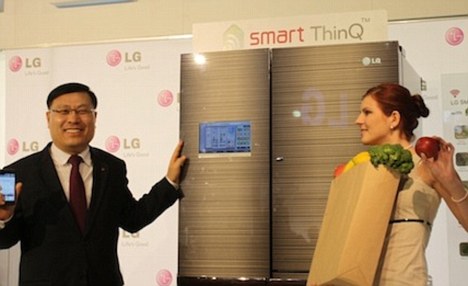
    Eating too much? Perhaps too little? Can’t find anyone to control your appetite? No worries, now you’ll be able to control any food aspect without the help of others. Now with LG’s ThinQ Smart Refrigerator that scans the food entered and consumed with a personal dietician installed, you can eat healthy and get advice on what to eat, and of course, what not to eat. 

    Using voice recognition and smart TV the fridge is able to know who is opening it, while you store your weight loss/gain targets, the fridge then uses that person’s details to give suggestions for other meal ideas, recipes, and healthier options.

    The fridge also includes an internal oven for recipes you wish for, and all at the same time has a high speed chiller that can take warm bottles and turn them to ice cold in 5-15 minutes.

    This high tech refrigerator can also scan barcodes of products inside and send you a text message when that product expires, while having inner cameras for you to check whats finished from your mobile phone a long distance away.

    Technology can’t get any better when it intervenes and enhances your appetite life and help you with food choice, diet, beverages, and health.


    http://www.dailymail.co.uk/femail/article-2084729/ThinQ-Smart-refrigerator-Talking-diet-fridge-keeps-weight-check.html

  • Smart car materials

    General Motors displayed newest latest innovation in the field of smart materials for its plans in the 21st century. New technologies such as shape memory alloys and polymers serve as future options for the development of GM in the field of cars. The materials are known to be able to change shape, stiffness or strength when either heat, stress, electric current or a magnetic field is applied and can then return to its former state when the stimulus is removed.

    The discovery of these materials could eventually lead to many possible movable features in cars, and we may even see prototypes as early as 2012. Examples of these advantages would be to include buttons and handles that automatically pop out when required, active surfaces that can move depending on cars speed to ease in the process of implementing effective aerodynamics results, and light-weight actuators and sensors that could replace the heavy motors and hydraulic systems found in today’s cars. The possibility of the creation of cars that can self-heal in the event of damage, or can be designed to change color or appearance at the touch of a button are ones that are revolutionary to the automobile industry. Such a development in the field of cars can undoubtedly revolutionize the human aspect of technology because soon in the future cars can reach abilities never witnessed before, and also such a development will cut down on costs for many people.