The Design Technology Blog

Category: Uncategorized

  • Temperature Responsive Polymers/Thermo Responsive Polymers

    Temperature responsive polymers are polymers that exhibit a drastic and discontinuous change of their physical properties with temperature. The term is commonly used when the concerned property is the solubility in a given solvent but may also be used when other properties are affected. Thermoresponsive polymers belong to the class of stimuli responsive materials that are different from temperature sensitive materials whih change their properties continuously with environmental conditions. This polymers display a miscibility gap in their temperatue composition diagram. Depending on whether the miscibility gap is found at low or high temperatures, an upper or lower critical solution temperature exists, respectively.

    The areas of application are tissue engineering, liquid chromatography, drug delivery, and bioseparation. There are only few commercial applications exist.

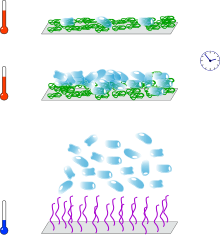
    Thermo responsive polymer chains in solution adapt an expanded coil conformation. At the phase separation temperature they collapse to form compact globuli. This process can be observed directly by methods of static and dynamic light scattering. Indirectly, the drop of viscosity can be observed. When mechanisms for the reduction of surface tension are absent the globule will aggregate, subsequently causing turbidity and the formation of visible particles.

    Polymers dissolve in a solvent when the Gibbs energy of the system decreases, i.e., the change of Gibbs energy (ΔG) is negative. From the known Legendre-Transformation of the Gibbs Helmholtz equation follows that ΔG is determined by the enthalpy of mixing (ΔH) and entropy of mixing (ΔS).

    \Delta G_{mix}=\Delta H_{mix}-T\cdot\Delta S_{mix}

    Adhesion of cells on a surface coated with a thermo responsive polymer. Displayed is a polymer with LCST.

    Thermoresponsivity in Organic Solvents:

    Due to the low entropy of mixing miscibility gaps are often observed for polymer solutions. Many polymers are known that show UCST or LCST behavior in organic solvents. Examples for organic polymer solutions with UCST are polystyrene in cyclohexane, polyethylene in diphenylether or polymethylmethacrylate in acetonitrile. 

    Thermoresponsivity in Water:

    Polymer solutions that show thermo responsivity in water are especially important since water as a solvent is cheap, safe and biologically relevant. Current research efforts focus on water-based applications like drug delivery systems, tissue engineering, bioseperation.

    http://en.wikipedia.org/wiki/Temperature-responsive_polymers
     

  • New “smart” material could help tap medical potential of tissue-penetrating light

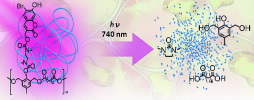
    Scientists are collaborating to try and create what may become the first type of light that can penetrate up to four inches in to the human body. They are developing and receiving successful initial results with the use of the smart materials. The discovery, if successful has the potential of being able to diagnose diseases as well as even create new human tissues. Experts say that the near-infrared (NIR) light is able to go 4 inches in to the human body, giving it immense potential for diagnosing as well as treating diseases. Though seemingly an immense advancement in medicine, there are still problems associated with its development. Currently, the materials that are being tested on are those requiring low-power NIR. This is because this level of power does not damage the body tissues as it passes through. However, the materials being used do not really respond as would hope, as they do not give the most accurate results. What is required is smart materials that can endure high-power NIR, though that does not seem like the best of solutions, as high-power NIR damages cells and tissues. This is why researchers have set their minds to creating a new polymer material that is capable of responding properly to low-power NIR light. With this advancement, the new material is such that it is able to separate in to small pieces that are resulting in signs showing that it is nontoxic to surrounding tissues. The researchers intend to place the polymer in hydrogel (water-containing flexible material that is used for forming tissues as well as drug delivery). This would enable the new polymer to be able to release the medications or agents in to the body when hit with low-power NIR, and so also eliminating/reducing the risk of damaging tissues. Though seemingly appearing as a dangerous substance, if developed as scientists are hoping, it will be a significant step in the field of medicine.


    http://portal.acs.org/portal/acs/corg/content?_nfpb=true&_pageLabel=PP_ARTICLEMAIN&node_id=223&content_id=CNBP_028638&use_sec=true&sec_url_var=region1&__uuid=7d9395c9-0827-4786-ac43-d41662763a59

  • Smart Insole

    People who have received an artificial leg, had a hip replacement, or who are recovering from a broken leg all want to avoid  developing a limp. Not only will it limit their mobility and increase the risk of falls, but it can also lead to problems such as osteoarthritis (osteoarthritis is a joint disease that mostly affects cartilage. Cartilage is the slippery tissue that covers the ends of bones in a joint. Healthy cartilage allows bones to glide over each other. In osteoarthritis, the top layer of cartilage breaks down and wears away.) That’s why mechanical engineer Prof. Stacy Bamberg is developing the Rapid Rehab system, it’s a “smart” insole paired to a smart phone app, designed to provide users with feedback on how they walk.

    The gel insole combines two force-sensitive resistors that measure pressure when the patient’s foot is on the ground. It also contains an accelerometer for detecting leg movement, and a gyroscope (a device, used to provide stability or maintain a fixed orientation) for determining the angle and position of the foot.

    Data from all of those sensors is wireless and transmitted to a smartphone that uses a custom app to create a real-time profile of the patient’s gait. It will note any problems with their walking pattern, and then advise them via their choice of instant visual, audioStacy Bamberg and sole or sensory feedback.

    Rapid Rehab Sole


    Citation: 

    • ” Smart insole could help improve gait problems.” Design Engineering News, Products, Features and Research for Engineers. N.p., n.d. Web. 9 Dec. 2012. <http://www.eurekamagazine.co.uk/design-engineering-news/smart-insole/46176/>.
    • “Rapid Rehab.” Rapid Rehab. N.p., n.d. Web. 9 Dec. 2012. <http://images.gizmag.com/hero/rapidrehab.JPG>.
    • “Stacy with insole.” Stacy with insole. N.p., n.d. Web. 9 Dec. 2012. <http://www.engineering.com/Portals/0/BlogFiles/DesignerEdge/1112/Insole%20Offer%20More/Stacywithinsole.jpg>.
    • “carollorenz27: Smart insole designed to correct gait problems.” carollorenz27. N.p., n.d. Web. 9 Dec. 2012. <http://carollorenz27.blogspot.com/2012/11/smart-insole-designed-to-correct-gait.html>.
  • The Electric Car

    The Electric Car

    Federico Maroli

    An electric car is an automobile that is propelled by one electric motor or more, using electrical energy stored in batteries or another energy storage device. Electric Motors give electric cars instant torque, creating strong and smooth acceleration. Some cars have an electric motor that works when the driver is pushing “hard” on the throttle and a benzene motor that works when the driver is exceeding a certain speed. This allows the car to pollute less while driving around the city and driving at normal speeds on highways. Also Electric Cars are considered to be more expensive due to the fact that they are equipped with ultra-modern systems in their motors, however Hybrid Cars, since they are an innovation and an improvement of the “old” cars, they are accessible to “low income people”. One common positive effect these cars have is the decrease of air pollution and also noise pollution, which some people find incredibly annoying. Also, it will allow future generations to have a supply of fossil fuels of their own, in order to use them for public and private transport when they will need it.


    References:

    http://en.wikipedia.org/wiki/Electric_car

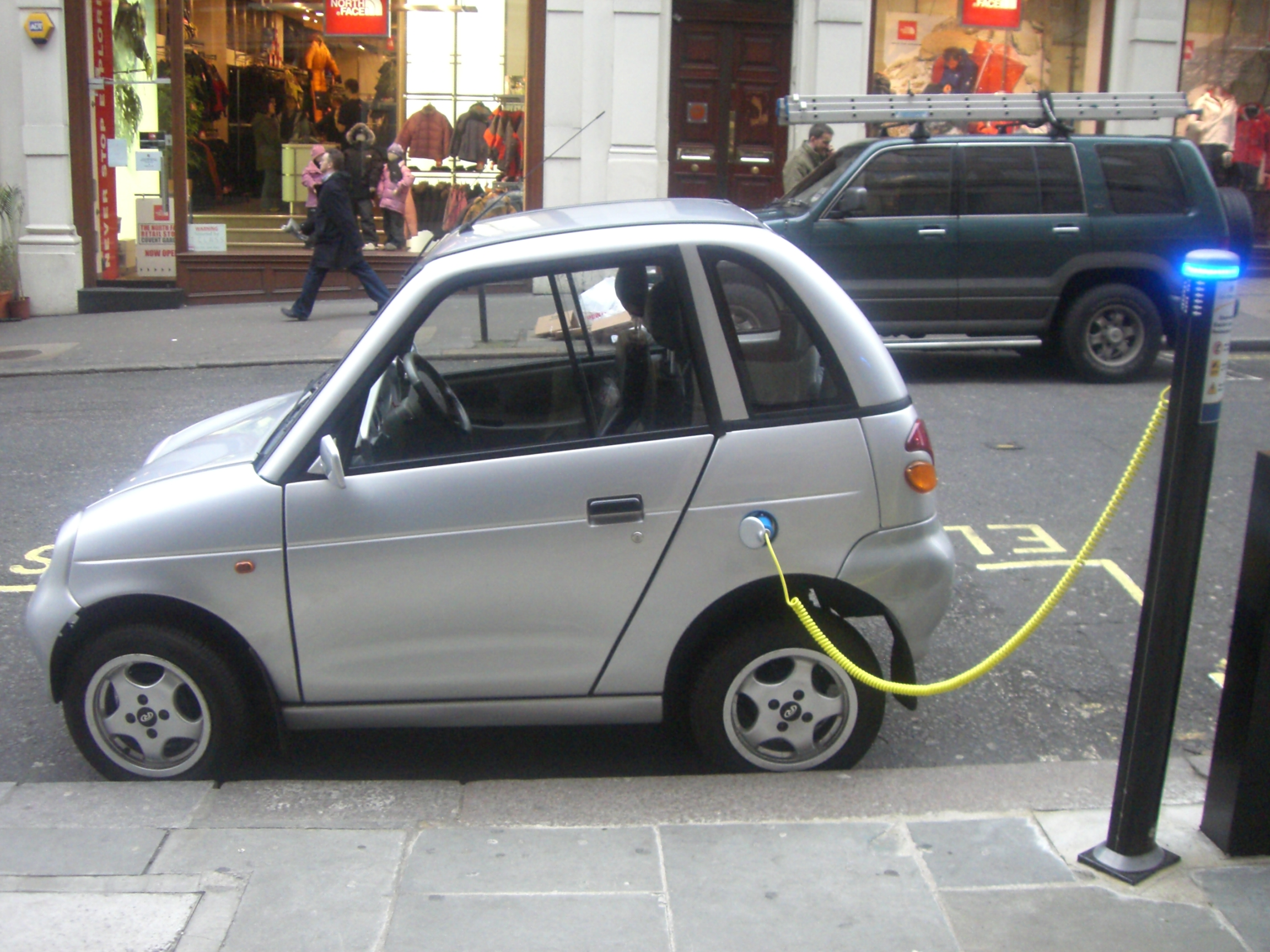
    -http://upload.wikimedia.org/wikipedia/commons/c/cc/Reva_charging.jpg

    Reva car charging in London
  • Car Invention

    The invention of car using combustion engine by Henry Ford was the most significant inventions of the 1920s, dramatically changing the lives of Americans.

    However the very first car invented was made with steam engine in 1866 by Richard Dudgeon.

    Throughout the first few years of the 1920s, cars became a hit with almost everyone, especially young people who desired for freedom and excitement.

    The cars also helped the companies and the industries of America. As people found it hard to drive on the dirt roads that were not in a suitable condition and that it required more fuel to run, America started road construction.


    Nation wide, the road construction created more jobs and strengthened the economy further.

      However as cars became overpopulated, they have been influencing our environment negatively.

    “The price of automobiles doesn’t begin to pay for the many indirect costs: waste of land and energy,loss of amenities,and the expenses of traffic enforcement, pollution and the cost of accidents by uninsured drivers…Society should stop paying the subsidies that keep this endless loop turning.”

       -Jane Jacobs. The Nature of Economics. Random House. 2000
    -Newrotoxins and carcinogens in car exhaust

    -Global Warming

    -Smog and acid rain

    -Ozone Depletion

    -Cars Reshape the Urban Environment

    -Passengers Die in Cars on a Daily Basis


    References

    • ” Cars: Their Impact on the Environment .” English Montreal School Board – Commission Scolaire English-Montréal. N.p., n.d. Web. 9 Dec. 2012. <http://www.emsb.qc.ca/laurenhill/science/cars.html>.
    • “The Invention of the Car .” ThinkQuest : Library. N.p., n.d. Web. 9 Dec. 2012. <http://library.thinkquest.org/J002604/LG-car.html>.
  • Innovative technology-OLED’s


    A technology that could be considered innovative are organic light-emitting diode, or OLED’s. These are organic compounds that will emit a color light if electricity is allowed to flow through them. These OLED’s are used in the digital display of many technologies, like phones, televisions, and handheld gaming consoles. Compared to LCD, they are better in many ways. OLED’s doing consume nearly as much power as a LCD, making the battery efficiently of them longer. The refreshing rate for OLED’s is much faster allowing the OLED’s to respond faster. Even though process of making OLED’s is more expensive than producing LCD’s, OLED’s can be made much cheaper, for instance if OLED screen printing becomes used for mass production. Finally, the brightness and clarity of OLED’s are much higher compared to LCD’s. They don’t need to have glass to be built with it, which would absorb some of the light. OLED’s are also multi-layered, which makes the picture clearer. In addition to being better, they are friendlier on the environment. First off, they do use as much electricity as the other two. This makes them cheaper than the other two to use. As well, less energy is needed to power them, which affects the overall energy output of power plants, lowering their pollution.  Additionally, when compared to LCD, is that LCD lights have mercury. Mercury is toxic to both the environment and to people, which is one of the negative effects of them. OLED’s do not use mercury, which allows them to be safer, as well as cheaper in terms of recycling cost. With LED’s, OLED’s are both built with the same materials. However, OLED’s need fewer materials to build the same color scheme. This allows OLED’s to be made with fewer materials, making less waste that might have to recycle later. Finally, OLED’s can be used longer compared to the other two. This allows as well less waste to be recycled, because there is less that you would have to recycle.

    References

    Freudenrich, Craig. “How OLEDs Work.” HowStuffWorks. N.p., 2012. Web. 09 Dec. 2012

    G, Tobias. Green OLED Light. Digital image. Wikipedia. N.p., 9 Jan. 2008. Web. 9 Dec. 2012.

  • The Plastic Water Bottle

    The plastic water bottle is an innovation known to all. The plastic  water bottle provides a way to carry around water anywhere you want to. The plastic water bottle also provides an easier way to acquire water overall. For example, you can buy a water bottle from any small kiosk or store in the area. It’s also easier to store water when it’s in bottles as well. Such as storing a large amount of water in your house, so that whenever you are thirsty, etc, then you can just immediately have a drink, instead of having to have a filter, or any other way in which you have to clean water.

    “Plastic Water Bottle.” The Thing Green Line Shop. N.p., n.d. Web. 9 Dec. 2012. <thethingreenlineshop.files.wordpress.com/2012/01/plastic-bottled-water.jpg>.
    Environmental and ethical issues include the danger to Earth as a whole, due to the harmful effects of the plastic that stores the water in the plastic water bottles. The plastic that is used in the water bottles is dumped into oceans, landfills, and pollutes the environment as a whole. Not only is the plastic dumped into oceans and landfills, but it’s also dumped into other random countries, such as India. India has tons of mountains of plastic bottles that still are being dumped upon to this day. Not only is bottled water messing up the environment, but bottled water is also messing up the economy, and the whole world as a whole. Over the past 10 years, the price of bottled water has tripled in cost. Even though bottled water is thousands of times more expensive than tap water, more and more Americans still drink bottled water over tap water. The result is that since more and more money is being spent on bottled water, more and more bottled water will be produced, which results in more plastic waste that is being dumped into oceans, and countries such as India. Water is more expensive than gasoline at this point, and it’s pointless to be buying water bottles, when you could drink tap water for almost free. In a way, water bottles are more harmful than gasoline, as the impact of both are technically the same, as they both pollute the environment as a whole. Humans in general should stop buying and drinking out of plastic water bottles, and instead switch to tap water. Tap water is clean, and is easier to access compared to bottled water. If humans could accomplish that, then the Earth would be a much cleaner and safer place than it is today.

  • Arch Bridges

    Arch Bridges are one of the main types of bridges currently spread across the world. The other types being suspension and beam bridges. The structure of an arch bridge consists mainly of an arch. The pathway can be either on the arch,

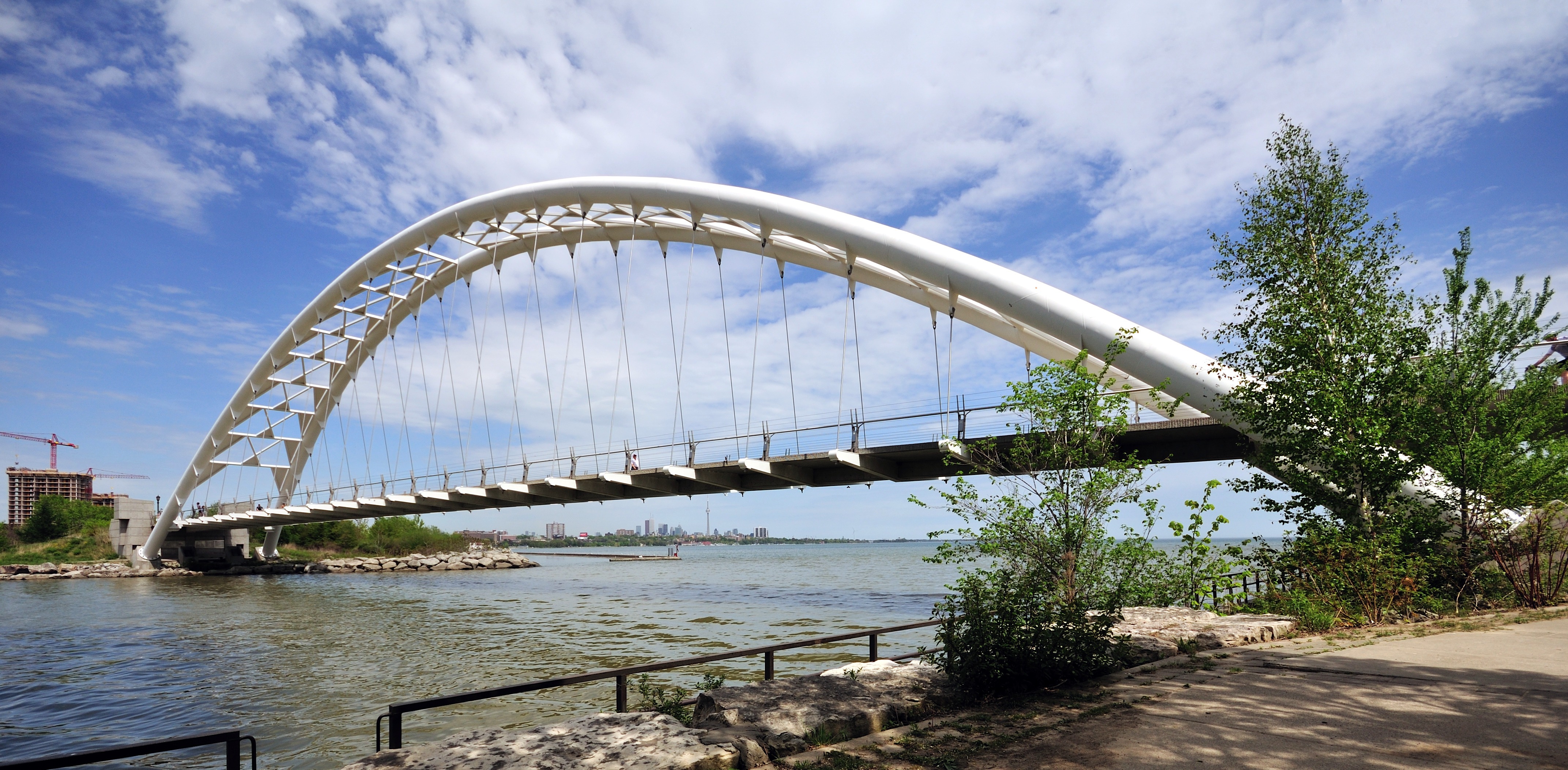
    below the arch or ontop of the arch. The pathway is never exactly on the arch, because near the ends of the arch the steepness would be to severe. The picture to the left shows how arches are used to suspend the path of the bridge. This is one of the ways that arch bridges are oriented. This bridge is the Humber Bay arch bridge in Toronto.


    Pictured to the right is the cold spring canyon arch bridge in Santa Barbara, California. In this bridge the pathway is ontop of the arch that supports it.


    Pictured below is Old bridge in Mostar, Bosnia and Herzegovina. This arch bridge, originally built by the Ottoman’s in the 16th , was designed by architect Hayruddin. A student of the famous architect Sinan. On this bridge the pathway is still supported by the arch but it also forms around the arch and is not completely flat. This bridge is not only importaint because it can let pedestrians cross the Neretva river, but it is Bosnia and Herzegovinas most recognisable landmark.


    Arch Bridges have a strong structure and have the advantage that there doesn’t need to be anything in the middle and the path for ships under the bridge is easily passable. The arches can be very large and still structurally support a long road without having pilars in the middle of the structure. All of the tension is put onto the foundations on the sides of the bridge. This is why it is importaint that the foundations are good with arch bridges.

  • Suspension Bridges


    Generally built over wide waterways, suspension bridges can prove beneficial to modern societies economically as their enable trade to occur more efficiently between countries. Suspension bridges span a large gap without restricting water travel of large ships belong them.

    Suspension bridges are efficient forms of transporting large loads as their form enables an equilibrium balance of forces that enable them to support the large load.  They are meticulously engineered to ensure that this equilibrium is present as otherwise an instability could lead to their destruction. The added flexibility of suspension bridges allows them to flex under the power of winds and earthquakes. During construction, temporary central supports do not need to be built, and access to the construction is not required from beneath. This means busy roadways and waterways do not need to be disrupted.

    However, a suspension bridge often entails a large opportunity cost to the country as it costs them billions of dollars to build, usually acquired through taxation.


  • Suspension Bridges

    Bridges are the result of our need to transport goods and people easily from one side of an obstacle to another. As a consequence of human ingenuity, the suspension bridge was developed. These bridges consist of some basic parts, the two supports on either side, the cables, and the bridge. Suspension bridges offer a different way of building a bridge and with it comes some advantages and disadvantages. In contrast to normal bridges which hold most of the weight of the  bridge and its load on the pillars and columns under it,  suspension bridges bear most of the load on the wires and support structures on opposite sides of the bridge. The load on these bridges is transformed into a tension in the wires of the bridge, which hold up the main bridge section.

    An advantage of these structures is their ability to be much taller than most other bridges, which allows them to be build over bays and large rivers while still allowing boats to pass under them. However, since such areas also have strong winds, this could be detrimental to the bridge. Suspension bridges are infamous for their flexibility and fragility when subjected to high speed winds. An example of this would be the Tacoma Narrows bridge, which bent and and shook during a particularly windy day which eventually caused it to fall. Heavy loads can also cause it to buckle and bend which is obviously a limitation of the design. Suspension bridges also require an extra strong foundation to build, which can greatly increase the cost of building one.

    Ultimately,  suspension bridges provide an alternative way of bridging gaps and crossing obstacles and a good addition to the world of structures.