—Super Conductors—
Have you ever been annoyed by the speed of your internet connection or the processing power of your computer? Did you ever consider what could be done to improve the quality of both? Well, a possibility lies in the development of superconductors.
The definition of a super conductor comes from the term “superconductivity” which relates to the electrical resistance a material exhibits. In a superconductor, or a material with superconductivity, this resistance is zero ohms or very near zero. Generally, this involves the cooling of a material to ultra low temperatures, such as below 20°K (-253°C). The cooling temperature varies between materials and is known as the transition temperature.
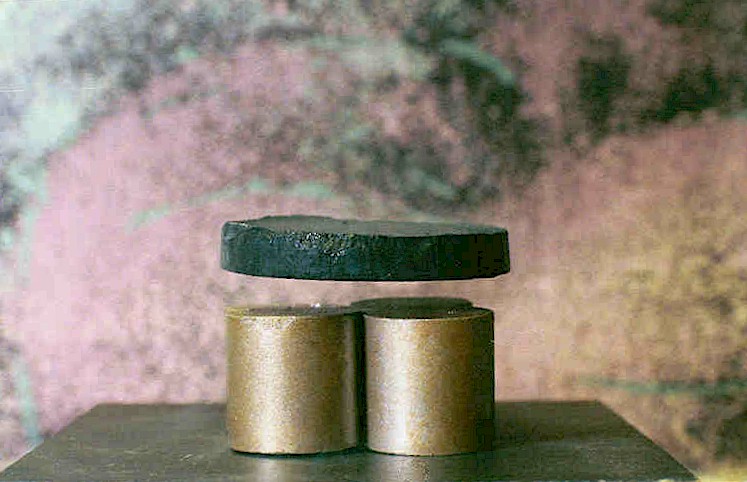
The extremely low electrical resistance of super conductors allow for several unusual, yet useful, properties unique to or exemplified by the super conductor. Among these are the Meissner effect, or the property of materials, when cooled to become super conductors, to gain influence on a magnetic field and repel the field, the flux trapping effect, or the establishment of attraction between a powerful magnet and a super conductor, and the resulting magnetic levitation/suspension effect. The simultaneous attraction and repulsion of a super conductor and a magnet allow for the magnet and super conductor to maintain a fixed distance away from each other in a very stable manner. In other words, the magnet, or in turn the superconductor, can float above the other while staying in place with very little friction. This is especially useful in the development of transportation; minimal friction levitation allows trains, or other modes of transportation, to move at maximum speeds in a noiseless manner. See the video below for more information. Other useful applications of the properties of super conductors include extremely efficient electrical wiring. Super conductors quickly and without resistance transport electricity, even if carrying only a minimal voltage. This allows for very sensitive equipment to be manufactured which can measure the most minute of electrical or magnetic discharges, changes, or disruption. Such machines are needed in the field of medicine for uses including brain examination and magnetic imaging. Super conductors, therefore, are useful in the manufacturing of more efficient and powerful motors, transformers, computer parts, and generators. A further suggested use is in a new energy storage medium: the magnetic energy-storage.
How Superconducting Levitation Works
The first documented research of super conductors came with the experiments done by in 1911 by the Dutch physicist Keike Kamerlingh Onnes with mercury wires. He discovered that mercury loses its electrical resistivity at below (4°K). Ensuing research made by scientists led to the development of higher and higher temperature super conductors. Super conductors were developed that consisted of multiple elements or were even metallic. The majority of super conductors in existence today are either alloys or ceramics. The highest temperature super conductors are actually ceramics with Hg2Ba2Ca2Cu3O8 at just above 130 degrees Kelvin. Today, multiple universities and companies around the world, work to produce cheaper and higher temperature super conductors. Unfortunately, most superconductors are expensive to produce, utilizing rare elements.
Sources:
“superconductivity.” Encyclopædia Britannica. Encyclopædia Britannica Online. Encyclopædia Britannica, 2011. Web. 06 Mar. 2011.
qwest.net


Leave a Reply
You must be logged in to post a comment.