The Design Technology Blog

Category: Design

  • 3D Printing- Food- Saving Lives

    3D printing is a process of making three dimensional solid objects from a digital model, and performed by a materials printer using digital technology. 3D printing has come up with a way to end hunger. 3D printing can end hunger by creating 3D food.

    null

    3D printed food will affect mankind, as it will feed everyone. According to the “contacter”, 3D printing meanms the end of food waste. If ever the worlds population reaches its peak, the people will not be able to live due to hunger. However, due to the 3d printed foods, people will be able to live without hunger. The machines will have powder that is shelf stable for up to 30 years, having all the nutrients.The 3D printing affects the society socialy as not only the rich will be able to never face hunger, but also the poor. The 3D printer will provide the poor with food at a lower price.

    Not only will3D printing help the people from being exposed to hunger, it will also save lives. On May 22nd 2013, a baby was saved by 3D printing from tracheomalacia, which is a diease that causes the windpipe to collapse. After being given the permission the doctors were allowed to use the 3D printed part in order to save the baby.

    This shows a future of advancement in medicine. 3D will help save lives that are suffering. This as said before, will lead to an adfvancement in medicine, and save many lives, moreover, it will make the process of organ donation faster as the patient will not have to wait for an organ donor, instead the organ can be 3D printed.

    In conclusion, 3D printing is an excellent invention, as in the soon future it will be saving lives due to organ donation and prevention of hunger.


    References:
    “3D Printed Medical Device Saves Baby’s Life | Video – Live Science | e! Science News.” e! Science News | Latest science news articles. N.p., n.d. Web. 23 May 2013. http://esciencenews.com/sources/live.science/2013/05/22/3d.printed.medical.device.saves.babys.life.video.
     
    “The Audacious Plan to End Hunger With 3D-Printed Food.” Mashable. N.p., n.d. Web. 23 May 2013. http://mashable.com/2013/05/21/end-hunger-3d-printed-food/.
     
  • 3D Printed Bionic Ear

    3D printing is a porcess in which a three-dimensional solid object is made from a digital model. It is differentiated from most typical machining techniques that depend on the process of removing materials by cutting or drilling. It uses a digital technology that works for prototyping as well as distributed manufacturing in fields like industrial design, architecture, engineering and construction (AEC), automotive, aerospace, dental and medical industries, education, geographic information systems and civil engineering.

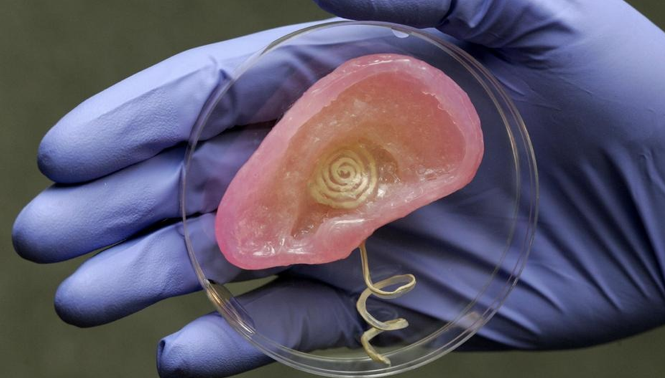
    Scientists at Princeton University have used 3D printing to design a bionic ear that can hear better than a normal human ear can. The printed ear intertwines embedded electronics, as the Princeton researchers 3D-printed nano particles and cells and combined cartilage with a small coil antenna to produce the bionic ear.

    The ear ended up hearing radio frequencies a million times higher than the average human ear. Lead researcher and assistant professor of mechanical and aerospace engineering at Princeton Michael McAlpine reported that “the way that our ear hears now is we pick up acoustic signals and then we convert those into electrical signals that go to our brain. What this ear does is it has this electronic coil on it and it picks up electronic signals directly.” The research team wanted to ask the question of whether it would be possible to grow an organ in a petri dish with intertwined electronics as the organ developed. The successful bionic ear was made using a $1,000 3D printer to print the cells and electronics. Then, the ear was placed in a petri dish to allow the cells culture for 10 weeks into cartilage tissue.

    Professor McAlpine said that his team did not create the bionic ear to help the deaf or those without ears, but rather “The idea of this was: can you take a normal, healthy, average human and give them superpower that they wouldn’t normally have?”

    Works Cited:

    “3D printing – Wikipedia, the free encyclopedia.” Wikipedia, the free encyclopedia. N.p., n.d. Web. 22 May 2013. <http://en.wikipedia.org/wiki/3D_printing>.

    Ramachandran, Vignesh. “3D-Printed ‘Bionic’ Ear Can Hear Beyond Human Ability.” Mashable. N.p., n.d. Web. 22 May 2013. <http://mashable.com/2013/05/24/3d-printed-ear-princeton/>.

  • Fibreglass – Omar Elgebaly

    Fiberglass is a fibre reinforced glazs which is held together by a plastic matrix. The material itself is lightweight and extremely strong. Common uses of fibre glass include boats, bike frames, windows, surfboards, etc. It’s lightweight and inherent strength yield a reliably weather resistant product, making it extremely versatile in it’s uses. It was developed in World War II as a replacement for molded plywood used in aircraft radars, as it was transparent to microwaves. It’s first civilian application was for boats and soorts car frames. After that, it started gaining acceptance towards the 1950’s. Since then, use of this material has widely broadened.

    It is currently a matter of debate as to whether fibreglass has a negative impact on health. in the 1950’s, fibreglass became a popular alternative for asbestos. As it is widely known asbestos cause deteriorating health effects, people have started wondering as to whether fibreglass displayed similar harmful effects due to their similarities. Although a great deal of debate surrounds this phenomena, it has been agreed upon that fibreglass is an irritant. Skin irritation is assiciated with the thick fibres of  filamentous glass. It has also been known to cause eye and throat irritation. If one is exposed to prolonged exposure, it may cause difficulty in breathing, which goes away once yiu are removed from it’s vicinity. It is also currently a subject of debate on whether it is carcinogenic. Hiwever, sufficient evidence has not yet been provided. It has some environmental implications, one such being is that it is not environmentally degradable. It’s biggest con is it’s disposal.


    Sources:

    http://greenhomeguide.com/askapro/question/what-is-the-environmental-footprint-for-manufacturing-fiberglass-windows-i-m-interested-in-fiberglass-because-it-s-supposedly-more-energy-efficient-than-aluminum

    http://www.einstein.yu.edu/administration/environmental-health-safety/industrial-hygiene/fiberglass.aspx

  • Fiberglass

    Fiberglass is an incredibly versatile material and it comes in several forms. Almost everyone has seen fiberglass insulation and anyone who has touched it will recall the itchy feeling often with a little rash which develops afterwards. This Is because the minute shards of glass cut into the skin and cause irritation.

    The fiberglass used in the automotive industry is different from insulation fiberglass. It usually comes in a mat, tissue or cloth, although a chopped strand mixed with resin is often used for large applications such as boat hulls.

    MATERIALS 

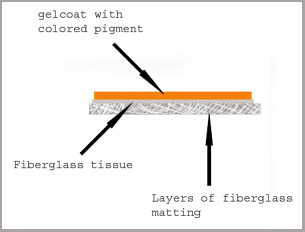
    Gelcoats are the shiny face of fiberglass, gelcoats are what you see on most fiberglass vehicles (which haven’t been painted) or boat hulls. Gelcoats consist of a thick gel-like resin mixed with a colored pigment, it is the first thing laid into a mold and therefore when the mold is removed it becomes the exterior.

    Below is simple diagram showing how many fiberglass bodies are constructed, there are other methods and this is just a common example.


    Tissue
    Fiberglass tissue as the name suggests is a very thin tissue like layer of fiberglass, it is very smooth and porous and the tissue sits underneath the gelcoat. Tissue helps to smooth out the inherent roughness of fiberglass matting, while also adding strength.

    Mat
    Fiberglass matting makes up the bulk of any fiberglass bodied car. Several layers are built up one on top of another until the desired thickness and strength is achieved. This is what you might see if you look at the inside of a fiberglass panel.

    Cloth
    Fiberglass cloth is strong and is often used where it may be visible and therefore aesthetics are important. One of the downsides of fiberglass cloth is that because the strands are neatly woven the layers do not intermesh like they do with the disorganised and loose strands on the fiberglass mat. Therefore the layers of cloth sit on top of one another, rather than meshing together like the fiberglass mat.

    Resin and Hardener
    Without resin the fiberglass itself would be useless for building anything requiring rigidity. Resin is mixed with a catalyst before application to the fiberglass. The drying process involves a chemical reaction which has several variables including, the amount of catalyst, temperature, humidity, and any water present in the fiberglass resin (water shouldn’t be there!).

    End result
    The results which can be achieved with fiberglass are quite impressive. Once fully hardened and sealed with resin or a gelcoat fiberglass is waterproof, relatively light weight and when done properly it is extremely strong. It is reasonably inexpensive when compared to the alternatives, in short it is an ideal material for the automotive field.

    http://www.fiberglasswarehouse.com/index.php

    http://www.inlinefiberglass.com/

    http://www.uscomposites.com/cloth.html


  • Water JetPack

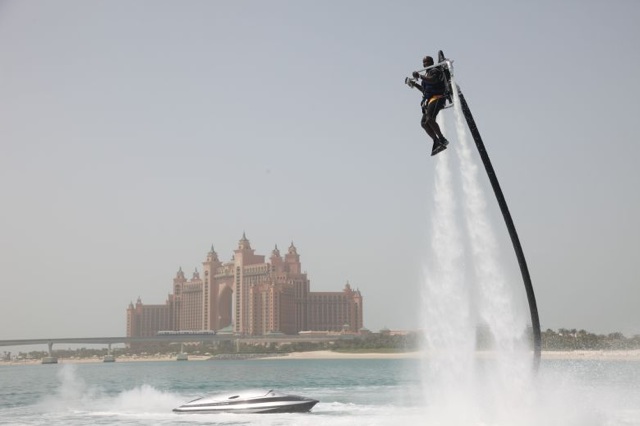
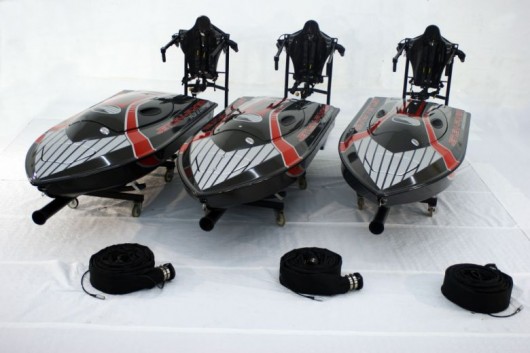
    Everyone would like to be able to fly above the water, for unlimited time, and that is exactly what Jetlev-Flyer allows you to do. It is designed by a company named MS Watersports GmbH, a German company. The water jet pack is easy to maneuver and extremely stable, the main website explains that “the bilateral nozzles are positioned higher than your center of gravity, so your body behaves like a pendulum or hanging flower pot. The nozzles are also designed to counteract against rolling motion from side-to-side. The hose and water inside it adds a great deal of extra weight below your center of gravity, so the higher you fly, the more roll stability you have. In forward motion, drag from the hose provides a third stabilizing point, ensuring stable forward motion. Finally, the jetpack’s rigid back rest, saddle and body harness keep your upper torso rigid while the trapeze prevents your legs from flailing in the air.” So those qualities make the jet pack extremely flexible for the user allowing ease of use, and anyone older than 18 years old can use it, as long as they are in good physical shape and good health. The JetLev-Flyer can go up to a maximum of 30 feet above the water, and if someone falls, they will be falling at a speed less than 30mph and the water drag will slow them down, so they won’t hit the water so hard that it will cause injuries, plus the users use protective equipment. Another cool thing is that the JetLev-Flyer was designed so it can take up to 6 minutes to learn how to use it, so in no time you will be able to fly above the water. It also allows you to do a certain moves, such as 90 and 180 turn while up on the water, also you can do tight turns and many other more moves. And for people that don’t like noisy products, the JetLev-Flyer has no engine and no moving parts other than the articulated thrust assembly, the only noise is the water jets making splashing noises when they enter the water and the boat unit which provides the water for the jetpack has a great sound insulation. In conclusion the JetLev-Flyer is a fun product to use, which allows you to fly around, plus the jetpack is a quiet, comfortable product, the only negative aspect is the insanely high price varying from 79,900 –  99,900 Euros, so in other words only people with a great amount of money can afford such product.


    For more information you can visit the main website at http://www.jetlev-flyer.com/home.html

  • Wireless power

    A few years ago there was a demonstration by a team at Fulton Innovation of a product called eCoupled. Using the principle of electromagnetic induction, by which an electrical charge can be stimulated in a wire coil by placing another one nearby, the crazy boffins were able to display wireless power transfer.

    Despite being high voltage, they said, it was safe, efficient and could be applied to any surface. The demo room consisted of a kitchen without plugs, but full of lights that could be stuck anywhere and a frying pan that heated up just by sitting it on the counter. Put a phone on the same counter and it began charging. Clearly, this was the future.


    wireless power


    Fulton are still working on wireless power, but it’s a different company that’s beat it to the shops, Powermat – and its products are expensive for something that replaces a 50p mains plug.

    The Wireless Power Consortium are going to be finalising a standard for wireless power called Qi later this year, which should mean prices drop and manufacturers have the confidence to build the technology straight into devices, rather than requiring an adaptor.

    Another similar technology is the  Airnergy by RCA. It’s a tiny dongle that can turn Wi-Fi signals back into electricity for charging phone batteries and the like.

  • Genibo the robotic dog

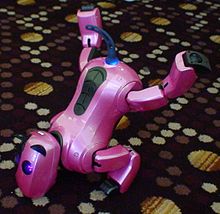
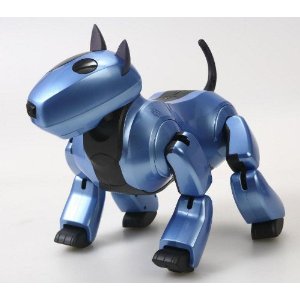
    The Genibo was produced by the Korean company Dasarobot of Dasatech. It is an autonomous pet robot. It was created to be much like a real life dog in appearance and behavior. It was modeled to resemble a Bull terrier. It can identify itself and the surroundings using its sensors, camera, and voice commands and share feelings with the user. With input information, it forms ‘Emotion/Mood/Intelligence/Character/Intimacy’ to feature unique character. It is capable of understanding over 100 voice commands (such as “sit”, “come here” and “do a headstand”) and has the ability to praise or scold the dog using the touch sensors located on its head, back and flank. The dogs mood will change according to user interaction and can express happiness, pleasure, sadness, surprise, anger, boredom and sleepiness. To control the robot, it comes with a PC Control Manager software that allows you to see a live view of what the dog is seeing, take photos, create skits/dance routines, record voice memos, MP3 playback, and set alarms.
    It functions with batteries that can be charged. Its width is 192 mm, length 334mm and its height is 330mm. The robot weighs 1.6 kgs. The cost of this product is 1500$.

    (As you can see, there are a variety of colors to choose from, including black, white, pink and blue.)

  • Robot builds copies of itself

    Robots-

    Reproduction is no longer unique for biology anymore. US researchers have created robots  that are able to reproduce other other robots out of spare parts. Though simple and toyish in size and function right now this may have a huge impact on several things. The robots will be able to repair each other and thus have several uses in such things as space travel. If a spaceship breaks down now, it is a huge risk to go out and fix the problem without putting astronauts in trouble.

    However, if robots gain the ability to reproduce they become even more like humans and one step further to being able to outnumber humans and take us over and enslave us. Hopefully this will never happen and the robots could even be made microscopic and could repair our innards.

    http://news.bbc.co.uk/2/hi/science/nature/4538547.stm

  • shape memory alloys in Aircrafts

    Shape memory alloys have several uses in today’s world such as being used in eye glasses and the original use of water piping. In today’s world people everywhere use airplanes to travel easily and safely across the world. However flying can be a nuisance as turbulence often annoys and even scares passengers, therefore designers have designed a type of wing which uses shape memory alloys in order to stop the turbulence.


    With its unique combination of  titanium, nickel and copper the wing is able to bend in a way so that it does not snap and is able to keep the plane upright much more then traditional wings.


    However more importantly Shape memory alloys will be used in a variety of different ways that can benefit humanity. There are examples of SMAs used in safety devices which will save lives in the future. Anti-scalding devices and fire-sprinklers utilizing SMAs are already on the market.

    In conclusion SMAs can be used in a variety of useful ways that can surely benefit mankind.

  • Ole Scheeran’s Mahanakhon Bangkok Tower

    The Architectural Design

    “Mahanakhon will be the most ambitious complex of contemporary architecture and design in Thailand and the tallest building in Bangkok.” – Ole Scheeran

    This  great modern architectural building, which began construction in the Fall of 2009, is said to be one of the best designs in the world. The Mahanakhon Bangkok Tower designed by German architect Ole Scheeren is planned to be the tallest construction in Bangkok, Thailand. Ole Scheeren  has unveiled plans for The Tower of Mahanakhon, a 77-story skyscraper. The building is due to be completed by 2012.
    The Architectural Design
    The complex will be 150,000 square meters (approximately 1,6 million square feet) and is a series of components that comprise the new Mahanakhon square, which will be a landscaped outdoor public plaza.  With distinctive sculptural appearance, Mahanakhon has been carefully carved to introduce a three dimensional ribbon of architectural ‘pixels’ that circle the tower’s full height, as if excavating portions of the elegant glass curtain wall to reveal the inner life of the building. The design has been created with purpose of revealing life inside the tower. On the other hand, the building has been following and taking security protocol into great consideration in order to ensure the successful construction of the project.  The building will include luxury retail and dining areas. Its glittering stacked surfaces, terraces and protrusions will simultaneously create the impression of digital pixilation and echo the irregularity of ancient mountain topography. This architectural geography is conceived to convey the energy, intensity and inclusiveness of Thai society and celebrate Bangkok’s emergence as a true global capital, fitting the Thai meaning of the name Mahanakhon, translated as ‘great metropolis’. The building plans to also feature an adjacent freestanding 7-storey building known as The Cube, which will offer multi-level indoor and outdoor terraces. This provides a network of social spaces with an extensive and carefully selected mix of dining and leisure facilities.

    A close up of the tower

    Inside Manakhanon

    The new project is intended as a novel public destination within the city. Manakhanon will include luxury retail space with lush gardens and terraces, a major transportation hub, and a five-star hotel designed by Ian Schrager. It will have multiple levels of restaurants, cafes and a 24 hour marketplace. It also plans on including  Ritz-Carlton residences. Each residence is offering the atmosphere of a sky box penthouse. The project is working in collaboration with Marriott International and renowned hotelier Ian Schrager.

    More about the Project

    “MahaNakhon will be the city’s tallest building, but more significantly it will

    accurately represent the audacity of Bangkok today – the optimism and strength ofThai culture and the value of that culture to Asia and the rest of the world.” –Sorapoj Techakraisri, CEO of PACE Development.

    Homes available at Mahanakhon will range in size from 125 square meters (1,350 square feet) to 830 square meters (8,930 square feet) with ceilings up to 3.5 meters high (approximately 11.5 feet).

    Prices for the residences range from $840,000 USD.

    The Mahanakhon Tower at Night

    Sources Listed:

    http://www.designboom.com/weblog/cat/9/view/7054/omaole-scheeren-mahanakhon-bangkok.html

    http://www.archdaily.com/30025/mahanakhon-ole-scheeren-oma/mahanakhon_copyright_oma_ole_scheeren_v_22/

    http://www.archicentral.com/ole-scheeren-omas-design-for-mahanakhon-unveiled-22616/