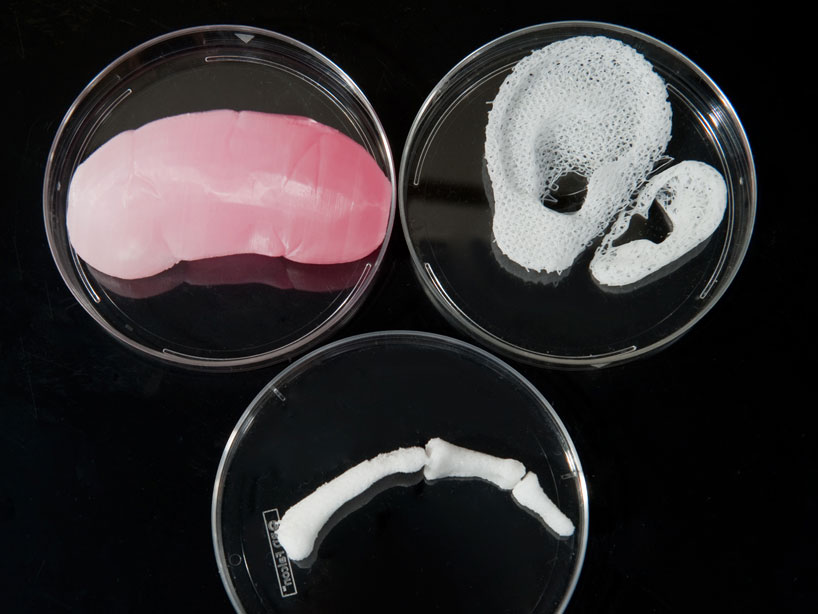
3D printed Organs
“Our approach is consistent with other forms of 3D printing because it’s an additive process,” says Renard, “but what is unique is our application of the process in the field of cell biology and tissue engineering.” There is a device revolutionizing creations and medical advancements! The act of 3D printing organs has become a new research topic for many scientists. The idea is to very carefully design and shape certain organs; after the organ is designed it is printed using a 3D printer. The Princeton researchers wanted to build on their knowledge, and so, the team joined up with researchers at Johns Hopkins to build the electronic ear. Their 3D printer combined calf cells with a hydrogen matrix material to form the ear cartilage, and silver to form the antenna coil. During testing, they were able to pick up radio waves in stereo using complimentary left and right side ears. Later on they hope to be able to detect acoustic energy directly using other built-in sensors. Other researchers have used 3D printing of a material called carbomorph to create that change resistance when bent or stressed. These researchers have also been able to print capacitive button sensors to measure changes in capacitance, and even connectors for hooking things together. An alternative to painful rib grafts, which result in ears that neither function well nor look natural, a normal ear is scanned and a mould made by a 3D printer. Collagen is injected into the mould, which acts as a scaffold in the formation of cartilage. The hope is that human trials could take place within three years. 3D printing has been used for pioneering work within foetal medicine, too. In 2009, Brazilian designer and Royal College of Art PhD student Jorge Lopes introduced the use of 3D printing to create models of unborn children within the womb. Lopes used MRI scans “to see inside the belly of a pregnant woman,” he says. 3D printing also has huge potential to help disability. Magic Arms is shortlisted for the Design Museum’s Design of the Year 2013, and enables Emma Lavelle, a child born with arthrogryposis, to use her arms, a function that was previously impossible. Magic Arms is Emma’s nickname for the Wilmington Robotic Exoskeleton (WREX), an assistive device made up of a bespoke butterfly-patterned jacket and arms that are 3D-printed in durable ABS plastic. The design was originally made with CNC technology for patients older than two-year-old Emma, but 3D printing enabled it to be translated into a smaller version that is light enough for Emma to wear and take everywhere. If a piece breaks, her mother can simply photograph the broken element and a new one is printed out and sent through the post. Clearly 3D printed organs have revolutionized both the medical and the engineering advancements, and will, hopefully, continue to do so.
“How 3D printing is changing health and medicine.” Dezeen – architecture and design magazine. N.p., n.d. Web. 21 May 2013. <http://www.dezeen.com/2013/05/19/3d-printing-organs-medicine-print-shift/>
http://www.designboom.com/wp-content/uploads/2013/02/regenerative01.jpg



 to the point where it is hard to find an area that does not have a direct impact on the food industry. Computer technology is also a central force, with computer networks and specialized software providing the support infrastructure to allow global movement of the myriad components involved.







 There are different types of Kevlar, they are all numbered and have their own use. Kevlar K-29 for example is used industrially for cables and brakes and armor while Kevlar K-49 is used in tires to replace rubber and bicycle frames but also in the hull of a boat because it is incredibly strong.