The Design Technology Blog

Author: Adam

  • Fiberglass

    Fiberglass is an incredibly versatile material and it comes in several forms. Almost everyone has seen fiberglass insulation and anyone who has touched it will recall the itchy feeling often with a little rash which develops afterwards. This Is because the minute shards of glass cut into the skin and cause irritation.

    The fiberglass used in the automotive industry is different from insulation fiberglass. It usually comes in a mat, tissue or cloth, although a chopped strand mixed with resin is often used for large applications such as boat hulls.

    MATERIALS 

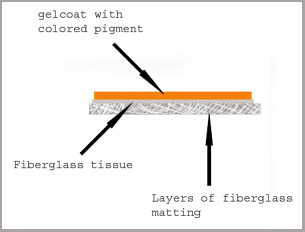
    Gelcoats are the shiny face of fiberglass, gelcoats are what you see on most fiberglass vehicles (which haven’t been painted) or boat hulls. Gelcoats consist of a thick gel-like resin mixed with a colored pigment, it is the first thing laid into a mold and therefore when the mold is removed it becomes the exterior.

    Below is simple diagram showing how many fiberglass bodies are constructed, there are other methods and this is just a common example.
     

    Tissue
    Fiberglass tissue as the name suggests is a very thin tissue like layer of fiberglass, it is very smooth and porous and the tissue sits underneath the gelcoat. Tissue helps to smooth out the inherent roughness of fiberglass matting, while also adding strength.

    Mat
    Fiberglass matting makes up the bulk of any fiberglass bodied car. Several layers are built up one on top of another until the desired thickness and strength is achieved. This is what you might see if you look at the inside of a fiberglass panel.

    Cloth
    Fiberglass cloth is strong and is often used where it may be visible and therefore aesthetics are important. One of the downsides of fiberglass cloth is that because the strands are neatly woven the layers do not intermesh like they do with the disorganised and loose strands on the fiberglass mat. Therefore the layers of cloth sit on top of one another, rather than meshing together like the fiberglass mat.

    Resin and Hardener
    Without resin the fiberglass itself would be useless for building anything requiring rigidity. Resin is mixed with a catalyst before application to the fiberglass. The drying process involves a chemical reaction which has several variables including, the amount of catalyst, temperature, humidity, and any water present in the fiberglass resin (water shouldn’t be there!).

    End result
    The results which can be achieved with fiberglass are quite impressive. Once fully hardened and sealed with resin or a gelcoat fiberglass is waterproof, relatively light weight and when done properly it is extremely strong. It is reasonably inexpensive when compared to the alternatives, in short it is an ideal material for the automotive field.

    http://www.fiberglasswarehouse.com/index.php

    http://www.inlinefiberglass.com/

    http://www.uscomposites.com/cloth.html


  • Food Industry

    The food industry is a complex, global collective of diverse businesses that together supply much of the food consumed by the world population. Only subsistence farmers, those who survive on what they grow, can be considered outside of the scope of the modern food industry.

    Processed food sales worldwide are approximately US$3.2 trillion. In the U.S., consumers spend approximately US$1 trillion annually on food, or nearly 10 percent of the Gross Domestic Product. Over 16.5 million people are employed in the food industry.

    In the United Kingdom, the food industry is extensive. It employs over half a million people and has a turnover of £70bn. It is the largest manufacturing sector in the UK and represents around 15% of the total manufacturing sector in the UK. Around 13% of the people working in manufacturing in the UK work in the food and drink industry.

    A vast global transportation network is required by the food industry in order to connect its numerous parts. These include suppliers, manufacturers, warehousing, retailers and the end consumers. There are also companies that add vitamins, minerals, and other necessary requirements during processing to make up for those lost during preparation. Wholesale markets for fresh food products have tended to decline in importance in OECD countries as well as in Latin America and some Asian countries as a result of the growth of supermarkets, which procure directly from farmers or through preferred suppliers, rather than going through markets.

    The constant and uninterrupted flow of food products from distribution centers to store locations is a important link in food industry operations. Distribution centers run more efficiently, output can be increased, costs can be lowered, and manpower better utilized if the proper steps are taken when setting up a material handling system in a warehouse.

    With populations around the world concentrating in urban areas, food buying is increasingly removed from all aspects of food production. This is a relatively recent development, having taken place mainly over the last 50 years. The supermarket is the defining retail element of the food industry, where tens of thousands of products are gathered in one location, in continuous, year-round supply. Restaurants, Cafes, Bakeries and Mobile trucks are also ways consumers can purchase food.

    Food preparation is another area where change in recent decades has been evident. Today, two food industry sectors are in apparent competition to top the food industry. The grocery industry sells fresh and largely raw products for consumers to use as ingredients in home cooking. The food service industry by contrast offers prepared food, either as finished products, or as partially prepared components for final . “assembly”.

    Sophisticated technologies define modern food production. They include many areas. Agricultural machinery, originally led by the tractor, has practically eliminated human labor in many areas of production. Biotechnology is driving much change, in areas as diverse as agrochemicals, plant breeding and food processing. Many other areas of technology are also involved, to the point where it is hard to find an area that does not have a direct impact on the food industry. Computer technology is also a central force, with computer networks and specialized software providing the support infrastructure to allow global movement of the myriad components involved.
    www.ibef.org/industry/foodindustry.aspx

    www.indianfoodindustry.net/

    www.food.gov.uk/foodindustry/

  • Touchscreen

    A touchscreen is an electronic visual display that can detect the presence and location of a touch within the display area. The term generally refers to touching the display of the device with a finger or hand. Touchscreens can also sense other passive objects, such as a stylus. Touchscreen is common in devices such as all-in-one computers, tablet computers, and smartphones.

    The touchscreen has two main attributes. First, it enables one to interact directly with what is displayed, rather than indirectly with a cursor controlled by a mouse or touchpad. Secondly, it lets one do so without requiring any intermediate device that would need to be held in the hand. Such displays can be attached to computers, or to networks as terminals. They also play a prominent role in the design of digital appliances such as the personal digital assistant (PDA), satellite navigation devices, mobile phones, and video games.

    The first touch screen was a capacitive touch screen developed by E.A. Johnson at the Royal Radar Establishment, Malvern, UK. The inventor briefly described his work in a short article published in 1965 and then more fully – along with photographs and diagrams – in an article published in 1967. A description of the applicability of the touch technology for air traffic control was described in an article published in 1968.

    Technologies

    Resistive

    A resistive touchscreen panel is composed of several layers, the most important of which are two thin, electrically conductive layers separated by a narrow gap. When an object, such as a finger, presses down on a point on the panel’s outer surface the two metallic layers become connected at that point: the panel then behaves as a pair of voltage dividers with connected outputs. This causes a change in the electrical current, which is registered as a touch event and sent to the controller for processing.

    Surface acoustic wave

    Surface acoustic wave (SAW) technology uses ultrasonic waves that pass over the touchscreen panel. When the panel is touched, a portion of the wave is absorbed. This change in the ultrasonic waves registers the position of the touch event and sends this information to the controller for processing. Surface wave touchscreen panels can be damaged by outside elements. Contaminants on the surface can also interfere with the functionality of the touchscreen.

    Infrared

    An infrared touchscreen uses an array of X-Y infrared LED and photodetector pairs around the edges of the screen to detect a disruption in the pattern of LED beams. These LED beams cross each other in vertical and horizontal patterns. This helps the sensors pick up the exact location of the touch. A major benefit of such a system is that it can detect essentially any input including a finger, gloved finger, stylus or pen. It is generally used in outdoor applications and point of sale systems which can’t rely on a conductor (such as a bare finger) to activate the touchscreen. Unlike capacitive touchscreens, infrared touchscreens do not require any patterning on the glass which increases durability and optical clarity of the overall system.

    Acoustic pulse recognition

    This system, introduced by Tyco International’s Elo division in 2006, uses piezoelectric transducers located at various positions around the screen to turn the mechanical energy of a touch (vibration) into an electronic signal. The screen hardware then uses an algorithm to determine the location of the touch based on the transducer signals. The touchscreen itself is made of ordinary glass, giving it good durability and optical clarity. It is usually able to function with scratches and dust on the screen with good accuracy. The technology is also well suited to displays that are physically larger. As with the Dispersive Signal Technology system, after the initial touch, a motionless finger cannot be detected. However, for the same reason, the touch recognition is not disrupted by any resting objects.

    Construction

    There are several principal ways to build a touchscreen. The key goals are to recognize one or more fingers touching a display, to interpret the command that this represents, and to communicate the command to the appropriate application.

    In the most popular techniques, the capacitive or resistive approach, there are typically four layers;

    1. Top polyester coated with a transparent metallic conductive coating on the bottom
    2. Adhesive spacer
    3. Glass layer coated with a transparent metallic conductive coating on the top
    4. Adhesive layer on the backside of the glass for mounting.

    When a user touches the surface, the system records the change in the electrical current that flows through the display.

    http://computer.howstuffworks.com/question716.htm

    http://electronics.howstuffworks.com/iphone1.htm

    http://www.scholarshipsinindia.com/answer/touch_screens.html

  • PVC

    The thermosetting resins include phenolic resin and melamine resin, which are thermally hardened and never become soft again. Thermoplastic resins include PVC, polyethylene (PE), polystyrene (PS) and polypropylene (PP), which can be re-softened by heating.

    Usually, thermoplastics are supplied in the form of pelletised material (compounds) with additives (antioxidants, etc.) already blended in it. However, PVC resin is often supplied in powder form and long term storage is possible since the material is resistant to oxidation and degradation. Various additives and pigments are added to PVC during the processing stage, and the blend is then converted into PVC products.
    PVC is sometimes known as ‘Vinyl’ in Europe and predominantly so in North America. In Europe, ‘Vinyl’ usually refers to certain specific flexible applications, such as flooring, decorative sheets and artificial leather.

    PVC_pellets_(Ineos)WEB

    PVC is a thermoplastic made of 57% chlorine (derived from industrial grade salt) and 43% carbon (derived predominantly from oil / gas via ethylene). It is less dependent than other polymers on crude oil or natural gas, which are nonrenewable, and hence can be regarded as a natural resource saving plastic, in contrast to plastics such as PE, PP, PET and PS, which are totally dependent on oil or gas. This chlorine gives to PVC excellent fire resistance: when PVC is set on fire, the flames go out as the fire source is removed due to the material’s self-extinguishing properties.

    PVC is one of the most used plastic materials in the world. At global level, demand for PVC exceeds 35 million tonnes per annum and it is in constant growth (+5% on global average), with higher growth rates in the developing countries.

    It is the most widely used polymer in building and construction applications and over 60 per cent of Western Europe’s annual PVC production is used in this sector.

    PVC is a more economic material
    PVC products make life safer, more comfortable and more pleasurable. And, because PVC has an excellent ratio of economic cost to performance, it allows people of all income levels access to these important benefits. The diversity of PVC applications challenges the imagination. In everyday life, they are all around us, from construction profiles to medical devices, from roofing membranes to credit cards, from children’s toys to pipes for water and gas. Few other materials are as versatile or able to fulfil such demanding specifications. In this way, PVC facilitates creativity and innovation, making new possibilities.

    PVC underpins safety
    Wire and cables sheathed with PVC prevent potentially fatal electrical accidents. In hospitals around the world PVC medical tubing – which does not break or kink – delivers fluids and medicines to the sick. Car components which use very strong PVC can reduce the risk of any injuries being caused in case of an accident. Most PVC products are long lasting – up to and over 60 years. These applications are reliable throughout their service lives and cut down vastly on maintenance or repair. Modern cars, for example, last many years longer simply because PVC protects the underside from water and corrosion.

    PVC enhances our lives
    Functional performance is by no means the whole story. PVC has a distinguished role in beauty and aesthetics. In fashion, furniture and all types of indoor and outdoor accessories, PVC opens up functional and design opportunities that are both visually striking and fundamentally practical. In short, people everywhere benefit from this material. Sometimes invisible but always reliable, PVC products make the difference when it counts.

    References:

    The European Council of Vinyl Manufacturers