About:
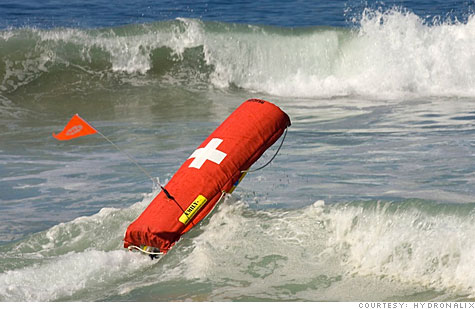
This robot was invented by inventor, entrepreneur and engineer Tony Mulligan. Named EMILY, an abbreviation of Emergency Integrated Lifesaving Lanyard, it “can swim through riptides at a speed of up to 24 miles per hour.” This makes it 15 times as fat as a human lifeguard, according to Mulligan.
“It is powered with an electric pump that shoots a forceful stream of water”, and “has been tested at California’s Zuma Beach.” Lifeguards are in control of the robot, through a remote. The 2011 model features sonar technology and is controlled with an iPhone app, allowing it to detect riptides and people who have drowned.
Reactions:
1. ” ‘From a technology perspective, [Emily] is quite innovative,’ says Howie Choset, a robotics professor at Carnegie Mellon University. ‘To be able to maneuver such a small craft through choppy waters straight to a drowning victim is incredible.’ ”
2. ” ‘This is a classic example of an inventor’s idea of how to solve a problem that doesn’t necessarily coincide with reality,’ says B. Chris Brewster, president of the United States Lifesaving Association. He notes that a robotic floatation device — no matter how nifty — can’t save an unconscious swimmer.”
Video demonstrating how the robot works:
Sources:
http://www.time.com/time/specials/packages/article/0,28804,2029497_2030615_2029800,00.html
http://money.cnn.com/2010/10/25/technology/robot_lifeguard/index.htm


Leave a Reply
You must be logged in to post a comment.