The Design Technology Blog

Tag: innovation

  • 3D Printed Bionic Ear

    3D printing is a porcess in which a three-dimensional solid object is made from a digital model. It is differentiated from most typical machining techniques that depend on the process of removing materials by cutting or drilling. It uses a digital technology that works for prototyping as well as distributed manufacturing in fields like industrial design, architecture, engineering and construction (AEC), automotive, aerospace, dental and medical industries, education, geographic information systems and civil engineering.

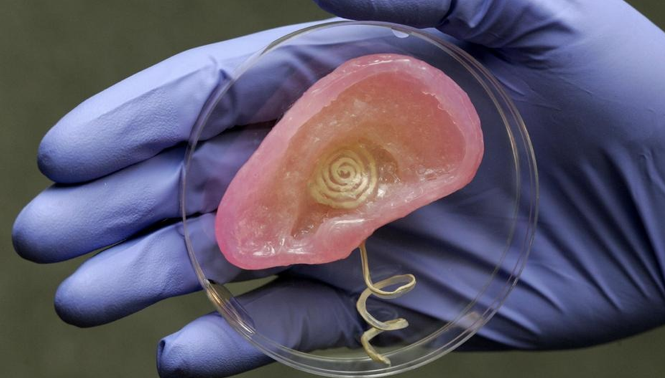
    Scientists at Princeton University have used 3D printing to design a bionic ear that can hear better than a normal human ear can. The printed ear intertwines embedded electronics, as the Princeton researchers 3D-printed nano particles and cells and combined cartilage with a small coil antenna to produce the bionic ear.

    The ear ended up hearing radio frequencies a million times higher than the average human ear. Lead researcher and assistant professor of mechanical and aerospace engineering at Princeton Michael McAlpine reported that “the way that our ear hears now is we pick up acoustic signals and then we convert those into electrical signals that go to our brain. What this ear does is it has this electronic coil on it and it picks up electronic signals directly.” The research team wanted to ask the question of whether it would be possible to grow an organ in a petri dish with intertwined electronics as the organ developed. The successful bionic ear was made using a $1,000 3D printer to print the cells and electronics. Then, the ear was placed in a petri dish to allow the cells culture for 10 weeks into cartilage tissue.

    Professor McAlpine said that his team did not create the bionic ear to help the deaf or those without ears, but rather “The idea of this was: can you take a normal, healthy, average human and give them superpower that they wouldn’t normally have?”

    Works Cited:

    “3D printing – Wikipedia, the free encyclopedia.” Wikipedia, the free encyclopedia. N.p., n.d. Web. 22 May 2013. <http://en.wikipedia.org/wiki/3D_printing>.

    Ramachandran, Vignesh. “3D-Printed ‘Bionic’ Ear Can Hear Beyond Human Ability.” Mashable. N.p., n.d. Web. 22 May 2013. <http://mashable.com/2013/05/24/3d-printed-ear-princeton/>.


  • Innovative Work- Earphone Alarm

    Earphone Alarm

    The Earphone Alarm, also known as a Anshinkun-2 is a new Japanese gadget that works as a small timer, worn just like an earphone. It’s very light, so it does not cause discomfort, and small so it’s not unattractive, nor does it get in the way. Its’ portable, and runs on batteries so it does not need to be plugged in or charged. This gadget is very useful for multiple things, such as if you’re on a train for example and fall asleep, the timer will go off to wake you up so you don’t miss your stop. Another bonus about the Anshinkun-2 is because it’s in your ear, it won’t disrupt other people, and only you can hear it. Other situations it would be useful in would be if you need to work for a certain amount of time, just set it to go off when you need to stop. It’s handy when cooking because you can time your food and walk around the house or go out and not miss the alarm on the cooker, for example. Another big selling point about it is its waterproof, so you can use in when showering or skiing. It’s manufactured by the Japanese company Honda Tsushin Kogyo, and sells on the market for 11 dollars.

    Though it is a great product, there are also environmental factors to take into consideration. An example of this would be the manufacturing that takes place, the use of the product and the disposal of the packaging and batteries that it needs to function, which are bad for the environment while being made, and if they are not recycled properly. Also, the actual making of the gadget is not environmentally friendly, because like many, if not all factories, the smoke and chemicals released while the product is being made are bad for the atmosphere. When the earphone alarm is actually made, it then has to be shipped to other various countries which will be selling the product. The shipping not only costs money, but the shipment also has to be disposed of once the product is in its designated area, or should be recycled properly which is no guarantee. Then once it has actually reached the destination in which it will be sold, its packaging has to be taken care of properly, or it’ll just be thrown away and regarded as waste. We also should take into consideration what will happen with the actual product or earphone alarm when the buyer has finished with it. It could be recycled for parts, but will most likely just be thrown away.


    Citations-

    – “i-store guide: 10/23/09.” i-store guide. N.p., n.d. Web. 9 Dec. 2012. <http://i-storeguide.blogspot.com/2009_10_23_archive

    – “Coolest New Inventions from Japan: Earphone Alarm – BusinessWeek.” BusinessWeek Slide Shows and Multimedia. N.p., n.d. Web. 9 Dec. 2012. <http://images.businessweek.com/ss/09/09


  • Green Building

    Green Building

    Sustainable building design

    The process:

    Green building is an environmentally responsible process that efficiently uses resources and lean production in order to minimize carbon emissions and damage towards the environment. This is a socially responsible practice that takes the effects of building into consideration. The common objective is that green buildings are designed to reduce the overall impact of the built environment on human health and the natural environment by; efficiently using energy, water, and other resources, protecting occupant health and improving employee productivity and reducing waste, pollution and environmental degradation. Green building does not specifically address the issue of the retrofitting existing homes.

    Building’s life-cycle:

    The building life-cycle ranges from design, construction, operation, maintenance, renovation, to demolition. This practice expands and complements the classical building design concerns of economy, utility, durability, and comfort.

    Natural building:

    This is a similar concept which is usually on a smaller scale and tends to focus on the use of natural materials that are available locally. Green architecture and sustainable design are other related topics. Sustainability may be defined as meeting the needs of present generations without compromising the ability of future generations to meet their needs.

    Green Building at CAC:

    The new elementary building at the Cairo American College (CAC) in Egypt was designed while meeting the standards of triple bottom line sustainability, “An expanded spectrum of values and criteria for measuring organizational success: economic, environmental and social.” The school also uses appropriate technology and focuses on sustainable development. This is shown through sustainable building.

    Objectives for sustainable buildings:

    • resource efficiency
    • energy efficiency
    • pollution prevention (including indoor air quality and noise abatement)
    • harmonization with the environment (including environmental assessment)
    • Integrated and systemic approaches (including environmental management systems).

    Video on sustainable buildings:

    watch?v=nAMrtHC2Ev0&feature=player_embedded

    Sources:

    http://www.getloans.com/blog/wp-content/uploads/2010/05/sustainable-building-design.jpg

    http://www.youtube.com/watch?v=nAMrtHC2Ev0&feature=player_embedded

    http://www.ruthtrumpold.id.au/designtech/pmwiki.php

    http://en.wikipedia.org/wiki/Green_building