The Design Technology Blog

Category: Sport

  • Water JetPack

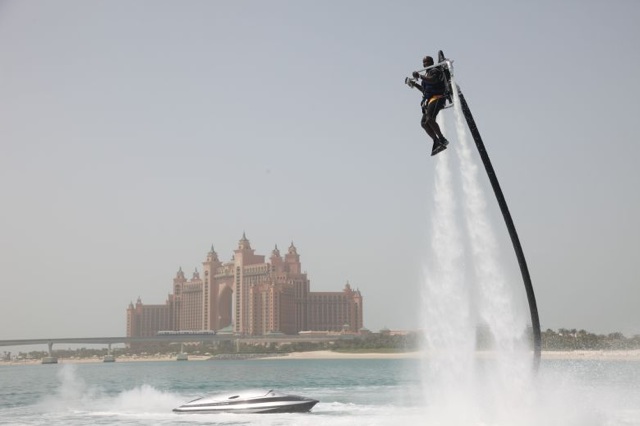
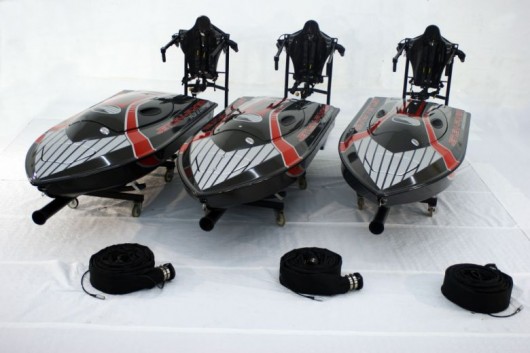
    Everyone would like to be able to fly above the water, for unlimited time, and that is exactly what Jetlev-Flyer allows you to do. It is designed by a company named MS Watersports GmbH, a German company. The water jet pack is easy to maneuver and extremely stable, the main website explains that “the bilateral nozzles are positioned higher than your center of gravity, so your body behaves like a pendulum or hanging flower pot. The nozzles are also designed to counteract against rolling motion from side-to-side. The hose and water inside it adds a great deal of extra weight below your center of gravity, so the higher you fly, the more roll stability you have. In forward motion, drag from the hose provides a third stabilizing point, ensuring stable forward motion. Finally, the jetpack’s rigid back rest, saddle and body harness keep your upper torso rigid while the trapeze prevents your legs from flailing in the air.” So those qualities make the jet pack extremely flexible for the user allowing ease of use, and anyone older than 18 years old can use it, as long as they are in good physical shape and good health. The JetLev-Flyer can go up to a maximum of 30 feet above the water, and if someone falls, they will be falling at a speed less than 30mph and the water drag will slow them down, so they won’t hit the water so hard that it will cause injuries, plus the users use protective equipment. Another cool thing is that the JetLev-Flyer was designed so it can take up to 6 minutes to learn how to use it, so in no time you will be able to fly above the water. It also allows you to do a certain moves, such as 90 and 180 turn while up on the water, also you can do tight turns and many other more moves. And for people that don’t like noisy products, the JetLev-Flyer has no engine and no moving parts other than the articulated thrust assembly, the only noise is the water jets making splashing noises when they enter the water and the boat unit which provides the water for the jetpack has a great sound insulation. In conclusion the JetLev-Flyer is a fun product to use, which allows you to fly around, plus the jetpack is a quiet, comfortable product, the only negative aspect is the insanely high price varying from 79,900 –  99,900 Euros, so in other words only people with a great amount of money can afford such product.


    For more information you can visit the main website at http://www.jetlev-flyer.com/home.html

  • Magnetic Stirrups

    Magnetic Stirrup Blog Entry

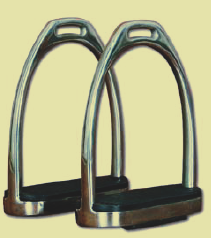
    This form of stirrups was made for everyone from young amateur riders, to Olympic riders. The problem that this innovation came to solve was that many riders had a fear of losing their stirrups while riding especially during the competition, and this in turn can affect the rider’s performance.  The Magnetic stirrup provided an insurance that such incidents will not happen. Not only so but it helps balance the rider on his horse and this creates rhythm and makes the rider have a better feel and always be with his horse. And it give the riders confidence because the rider knows that his stirrups will not be lost, and this can give him a greater insurance and feel of safety while riding, as well as give him a better and bigger chance to take risks while in the show.

    How the stirrups work:

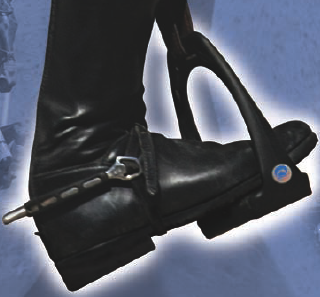
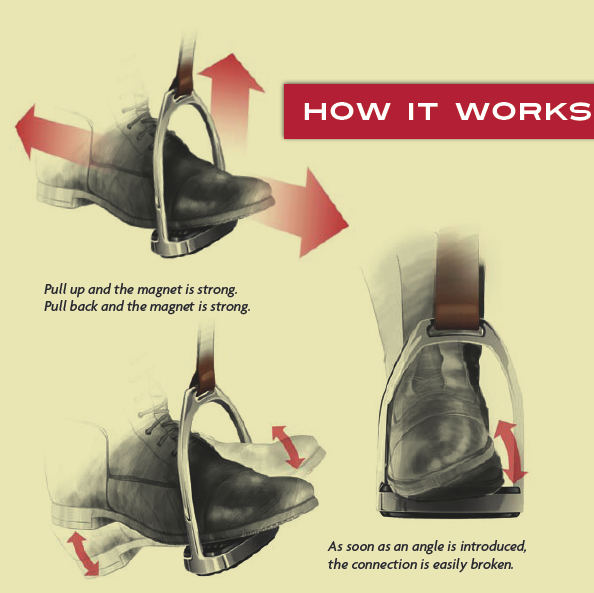
    The magnetic stirrups system is not sold alone. The stirrups are sold with their matching pairs of boots. Together the stirrups and the boots work and both are magnetized to provide the safety and insurance needed by the rider. The magnet is located on the stirrup in the area where the boot sits. A corresponding metal is placed on the sole of the boot so that it is automatically attracted when the rider inserts his legs into the stirrup. With precise engineering, the magnets and the metals are strong enough to ensure that your leg does not slip while riding, yet at the same time make it easy to release when it is time for you to go off your horse or in times of an accident or emergency.

    Benefits of the Magnetic stirrup:

    To provide the safety needed and comfort of fitting your foot into the stirrups while riding, but at the same time make it easy to release in case of a fall or emergency.

    Providing better control while riding and this is done by ensuring that your foot is placed properly into the stirrups, and this improves both body and leg positions, therefore enhancing the rider, and the horse’s performance.

    Provide the best contact between the horse and rider by ensuring correct leg position. This gives you the confidence needed for a good ride.

    Improving the quality of the ride for all riding ages and levels of expertise, and this is because now the rider does not have to think about his leg position, and can focus on other matters.

    Providing Stability and security for the rider while on the horse, and this is by ensuring that when the leg is properly place in the stirrups, it will not be released.

    Customization:

    The Magnetic stirrup is available for 2 different types of riding. Show jumping, and Eventing and they both have the different stirrups. And they also come in different sizes.

    There are a variety of boot sizes, and shapes that fit the Eventing and Show Jumping rider.

    There is also a magnetic piece that can be stuck on any boot so that you do not have to buy new boots when purchasing the stirrups. You can simply just add the magnetic piece. This also makes the Boot/Stirrup combinations easy to maintain because they can be easily changed later on.

    Acceptance:

    The Magnetic Stirrups has been approved by many of the national equestrian federations, including the FEI (Federation Equestrian International) and the International Olympic Committee and this is to make sure that all riders of any level can use the boots and stirrups.

    Advertising and testing

    One of the most important ways of promoting the new type of stirrups was that world famous riders personally tested them during daily training, and at shows. This method was expert appraisal because it ensured that the ideas of the expert riders were taken into account when the product was being developed.

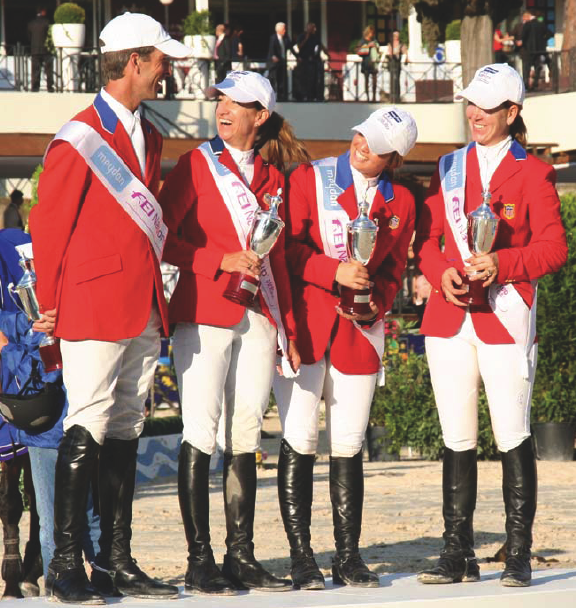
    Most of the riders that tested the stirrups, also promoted using it, and today the National Equestrian Team of the USA uses and promotes the Magnetic Stirrup.

    Sources:

    http://www.ontyte.com/

    http://www.youtube.com/watch?v=21FJFAueUXY

    http://www.doversaddlery.com/product.asp_Q_pn_E_X1-07084

  • Jabulani Ball

    Jabulani Ball

    History

    Throughout the history of football, people have been searching year after year for the perfect ball. It has been a quest to improve and improve a ball that is used in the most widespread sport in the world. World Cup after World Cup has seen new footballs with incremental changes in material between each one. In 1836, Charles Goodyear patented vulcanized rubber, he spent nearly 20 years in attempting to create a ball for football and finally he invented the first vulcanized rubber football in 1855. In 1862, H.J. Lindon developed one of the first inflatable rubber bladders for balls. “By the 1900’s bladders were made with stronger rubber and could withstand heavier pressure.  Most balls produced by that time used rubber bladders. The balls were made from inner tubes covered with heavy brown leather.  These balls would bounce easier and yet could be kicked. Most balls had a tanned leather cover with eighteen sections stitched together arranged in six panels of three strips each.” (soccerballworld.com). Throughout the next 70 years, leather balls were the only ones in the game and then in the 1970 world cup in Mexico, a revolutionary ball was introduced to the 32-Panel Adidas Telstar ball.

    The 2006 World Cup Ball, Teamgeist Ball

    This football was made from synthetic leather patches sewn together in a design based on the ‘Buckminster Ball’ or known as the Buckyball. For the next 36 years Footballs were made in this style with minimal change. In 2006, the Teamgeist. The introduction of a 14-panel construction method means that the number of three-panel touch points is reduced by 60% (60 to 24) and the total length of the panel lines falls by over 15% (400.5 cm to 339.3 cm). Building on the introduction of thermal bonding technology in 2004.

    Introduction Of Jabulani

    The ball is made from eight spherically molded panels and has a textured surface intended to improve aerodynamics. Nevertheless, the ball received extensive criticism from players and coaches before and during the World Cup who said that the path of the ball through the air was unpredictable.

    “The ball was constructed using a new design, consisting of eight (down from 14 in the last World Cup) thermally bonded, three-dimensional panels.

    The 2010 World Cup Ball, Jabulani

    These then are spherically molded from ethylene-vinyl acetate (EVA) and thermoplastic polyurethanes (TPU). The surface of the ball was textured with grooves, a technology developed by Adidas called “Grip ‘n’ Groove” that is intended to improve the ball’s aerodynamics. The design has received considerable academic input, being developed in partnership with researchers from Loughborough University, United Kingdom.” (Wikipedia). This table shows that the moulding technique means the ball retains its shape, and the lack of seaming means there is essentially zero water retention, which will reduce sluggishness of the ball.

    Personal Experience

    Through personal experiences I have been able to conclude that the unpredictability of the ball is both a good and a bad thing. As the unexpected behavior can trick a goal keeper, whilst at the same time, the speed makes control of the ball quite difficult.

    Resources

    http://www.jabulaniball.com/

    http://en.wikipedia.org/wiki/Adidas_Jabulani

    http://www.soccerballworld.com/Jabulani_2010.htm

    http://www.adidas.com/campaigns/football/content/products.aspx?collection=OMB

    http://en.wikipedia.org/wiki/Adidas_Teamgeist

    http://www.soccerballworld.com/History.htm

  • Kevlar

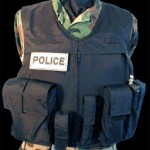
    Kevlar is a material developed by DuPont in 1965 but it was only used in 1970 for commercial use. Kevlar is used in body armor and armored vehicles, it is also applied in clothing to protect the user from cuts. Sports equipment such as bicycle tires to stop punctures, it is applied to table tennis paddles, motor cycle clothing, and racing sails. Kevlar has even been used in audio equipment since it has acoustic properties, drumheads, woodwind reeds, rope, cable, brakes, electricity generation, construction of buildings, and expansion hoses and joints.

    Kevlar is strong because of the weave which is very similar to small spider webs. It was invented by Stephanie Kwolek and Herbert Blades. The weave consists of a liquid and a solid also known as an aramid weave. These weaves corrode in exposed to chlorine but is resistant to heat.

    There are different types of Kevlar, they are all numbered and have their own use. Kevlar K-29 for example is used industrially for cables and brakes and armor while Kevlar K-49 is used in tires to replace rubber and bicycle frames but also in the hull of a boat because it is incredibly strong.

    The chemical composition of Kevlar is poly para-phenyleneterephthalamide (composite.about.com). Aramids belong in the nylon family.

    Kevlar is also very light and extremely strong of course and the tensile strength is high. However it does absorb moisture which makes it more sensitive to environments it is also harder to cut because you will need special scissors.

    The material is rather expensive to get and can get to about 33 dollars per yard but you have to buy in great amounts.

    This is a table of the three main Kevlar types 29, 49, and 149. (composite.about.com)

    Grade Density
    g/cm^3
    Tensile
    Modulus
    GPa
    Tensile
    Strength
    GPa
    Tensile
    Elongation
    %
    29 1.44 83 3.6 4.0
    49 1.44 131 3.6–4.1 2.8
    149 1.47 186 3.4 2.0

    Sources:

    http://composite.about.com/od/aboutcompositesplastics/l/aa050597.htm

    http://en.wikipedia.org/wiki/Kevlar#Production

    http://www.wisegeek.com/what-is-kevlar.htm

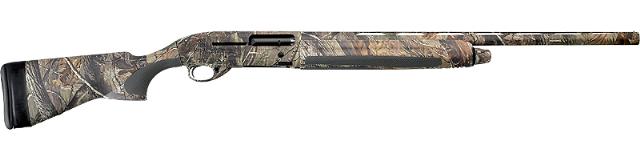
  • Beretta A391 xtremaA2

    NEW BERETTA A391 XTREMA2
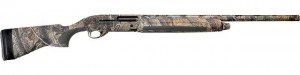
    Designed for the use of Super Magnum 12 ga. 3 ½ in. (89 mm) cartridges, but capable of functioning with lighter cartridges, the new Beretta A391 Xtrema2 gas operated semiautomatic is the ideal shotgun for long distance shooting and the most difficult game.

    MODERN DESIGN, ULTIMATE TECHNOLOGY
    Streamlined Shapes. The skilfully rounded receiver blends perfectly with the stock grip and it permits instinctive, rapid target acquisition. Impeccable balance makes this shotgun easy- and fast to handle. The strongly outlined sides of the receiver confer a distintinctive character to the gun.
    The slim fore-end and the stock boast a new ergonomic design that facilitates the ount of the shotgun. The accurate design of the trigger guard elegantly merges with the receiver.
    The enlarged opening of the trigger guard allows the use of gloves. The top of the receiver is designed to accept (with an optional Weaver base) optics and other aiming systems.
    Stock And Fore-End In Technopolymer.

    The stock and fore-end are produced in durable, resistant, fiberglass reinforced technopolymer that ensures anti-scratch properties and an improved feel in cold weather.Special extended soft plastic inserts are overmolded on the gripping areas of the stock and fore-end to guarantee a secure grip also in adverse weather conditions and to absorb vibrations when shooting.

    EXCLUSIVE AQUA TEK PROTECTION
    Aqua Technology is the name given to the exclusive special surface and protective treatments that are applied to the metal parts of the new Beretta A391 Xtrema2 shotgun.
    The steel barrel is chrome-plated inside to withstand the rigors of steel shot. The external surface of the barrel is first blued and then covered that an exclusive protective coating which remarkably increases its resistance to corrosion. The receiver is made of black anodized aluminum alloy and also boasts the same protective coating. All the internal parts are either nickel or chrome plated, or they are protected by a special process based on a ionic deposition which impregnates the surfaces with ceramic compounds and metals (e.g. Titanium, Chrome) guaranteeing a great resistance to wear and corrosion.

    This unique treatment, grey pearl in color, extends to the breech bolt group, the trigger and the carrier.
    The main internal springs (recoil spring, magazine tube spring, valve spring), the self-compensating valve and the rear drop/cast plate are made of stainless steel. The homogeneous matte black finish, which characterizes all the metal parts in view, boasts anti-glare properties.
    MINIMUM RECOIL, MAXIMUM PERFORMANCE
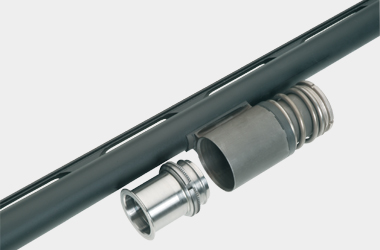
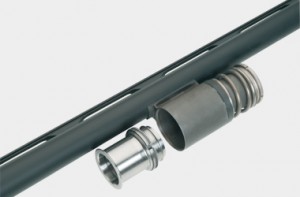
    Gas Operation System with Exhaust Valve. The unique gas operation system, patented by Beretta, with self-cleaning gas cylinder and piston, is provided with a self cleaning exhaust valve that automatically vents the excess gases of the most powerful cartridges.The result is that the shotgun, without any adjustment, fires everything from the weakest 28g (1 ounce, 3 ¾ dram equivalent) game load to the heaviest 64g (2 ¼ ounce) Super Magnum cartridge. The exhaust valve remains attached to the barrel, ensuring easy and quick assembly and disassembly of the shotgun.

    New Kick Off® Recoil Absorber
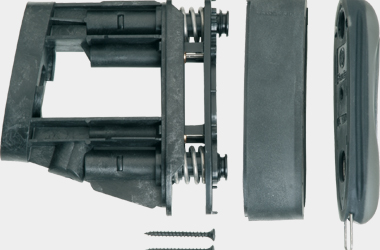
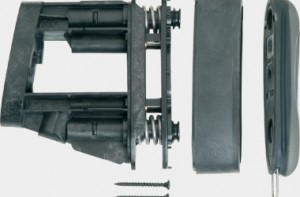
    The new Beretta patented Kick Off system  has been conceived to further reduce felt recoil when shooting. Thanks to the Kick Off device, the recoil energy is gradually dissipated by two hydraulic absorbers  inserted into the stock. The result is superior comfort for the shooter. At the same time, the vibrations and the muzzle jump when shooting are strongly reduced.

    Recoil Reduction System. A spring-mass recoil-reduction system, located inside the stock, counteracts the rearward forces generated by shooting and greatly reduces felt recoil.
    Bolt Travel Recoil Absorber. Manufactured from an advanced elastomer, it reduces the vibrations transmitted to the shooter and contributes to the shotgun’s reliability and durability.

    Adjustable Length of Pull. Thanks to the two stock spacers (one assembled) the length of pull of the Xtrema2 Standard model can be adjusted to all shooters.

    Gel•Tek Recoil Pad. It reduces felt recoil and vibrations transmitted to the shooter and is interchangeable with extreme ease.

    Rotating Bolt. The rotating bolt with two locking lugs guarantees maximum safety and reliability even with the heaviest cartridges. The operating rods are integral to the bolt body, ensuring that it is guided symmetrically and with minimal friction. The disassembly and reassembly of this unit is also simplified.

    Optima-Bore Barrel.
    The Optima-Bore internal barrel profile features an overbored diameter and lengthened forcing cone that considerably improve shot pattern distribution and felt recoil reduction.

    Optimachoke Plus Choke Tubes.
    The Beretta Optimachoke ,Plus tubes feature a long, gradual constriction, internal profile formed to minimize shot deformation and to enhance the concentration and distribution of shot patterns. Engineered to resist steel shot stress and corrosion.

    RICH ACCESSORIES

    The Beretta A391 Xtrema2 shotgun is supplied with a modern design case and a complement of accessories: additional set of stock drop/cast plates, 25 ml. Beretta Gun Oil, set of Optimachoke Plus choke tubes with spanner, stock spacer with assembly screws , front and rear sling swivels.

    Stock Drop and Cast Spacers. They allow the stock drop and cast to be adjusted by simply
    modifying their assembly position.

    Quick Detachable Sling Swivels. Thanks to an exclusive quick-release system it is possible to fasten
    and remove the rear swivel from the stock without any tools.

    BIBLIOGRAPHY:

    1. http://en.wikipedia.org/wiki/Beretta_Xtrema_2
    2. http://www.berettausa.com/products/a391-xtrema2/default.aspx
    3. http://www.e-gun.net/more.asp?gid=20484&gun=shotgun


  • Windsurfing Sails

    Windsurfing sails

    In windsurfing there are many types of sails to enhance speed and or maneuverability. These are many types of sails called free style, wave, freeride, stand-up/ paddle board, freemove, beginners, children, slalom, and lastly the race sail.

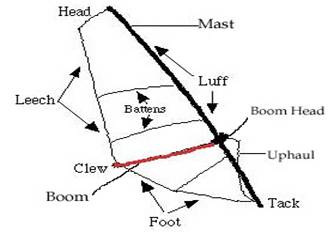
    The difference between these sails all depends on the design. The main aspects of the design are the material, the size, weight, the boom, the chambers, and the leech (see image). The three most common materials used for a windsurfing sail are Dacron (woven polyester), Mylar, and Monofilm. Dacron is used in the beginner’s sails, it is lightweight, cheap, but it can outstretch after over use. Mylar is actually a coated form of Dacron, it holds its shape better but it takes part in delamination overtime.  To strengthen areas of the sail they use Kevlar mesh.


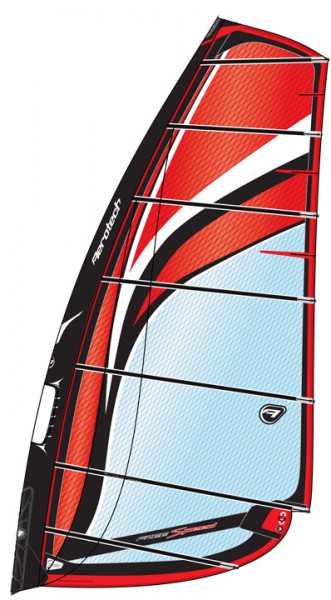
    A freeride (speed) sail
    Camber (the straight lines accross a sail)


     The difference between speed, freestyle and wave sails is the design of course. In a speed sail there are more chambers to maximize the shape of the sail. These cambers lock the shape to increase the amount of wind that can be captured to increase speed.

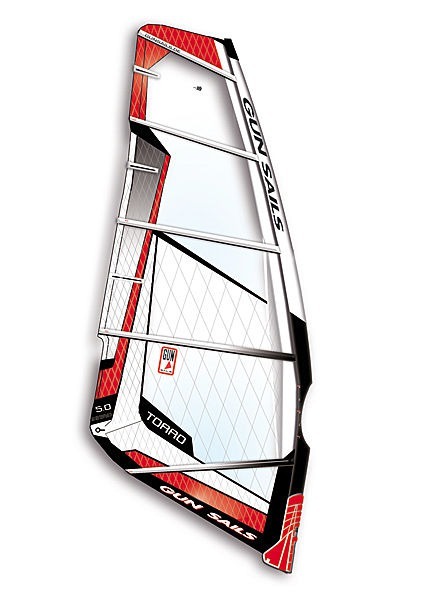
    A freestyle sail has cambers that are at a greater angle compared to a speed sail. Also there are less cambers since freestyle sails needs maneuverability and quick turns, more cambers will increase the difficulty of the turns which is not needed in a freestyle sail.  

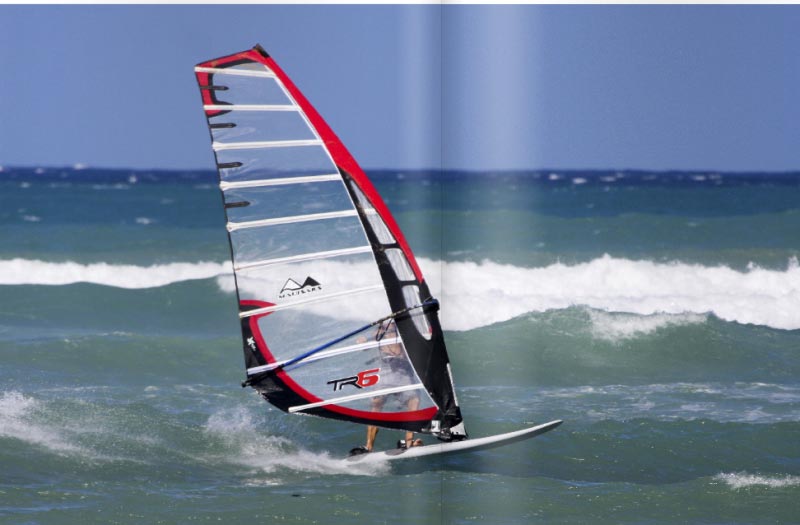
    Wave sails are made of stronger materials that can handle a beating if something goes wrong. Wave sails are made to easily change directions and have a good handling. Also, wave sails have fewer cambers to increase handling, but not loose speed. Another design difference is the end (rear) of a sail, for speed the sails extend out and down further than wave sails, because wave sails cannot get caught in the waves.

    A wave sail

    Notice how the rear is cut higher and shorter than that of the speed sail.

    A freestyle sail

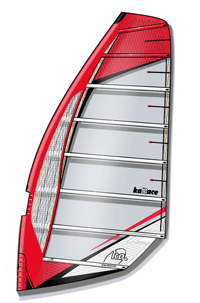
    A combination of both a speed and wave sail.

    Personally I sail with freestyle sails but I do want to try speed and wave sails. There are many different sizes to fit the person who sails them (this affects weight), I can handle a 4.5m^2 which is about twice my size.

     Bibliography:

    http://www.nauticexpo.com/boat-manufacturer/windsurf-sail-891-_2.html

    http://eartheasy.com/windsurfpage.htm

    http://www.seabreeze.com.au/Articles/Windsurfing/Whats-the-difference-between-sails_903109.aspx

    By Vera Butter

  • Reebok ZigTech (Analysis)

    Haven’t you ever wanted to run longer but was too exhausted to continue? Maybe you were suffering muscle pains after a hard workout and was forced to skip the following day’s practice? Whatever the reason or excuse you might have came up with the new ZigTech shoes made by Reebok will make sure you will never miss a day or practice ever again. The new advanced technology put into the creation of these new series of shoes is revolutionary and one of a kind.

    Design and Unique Structure

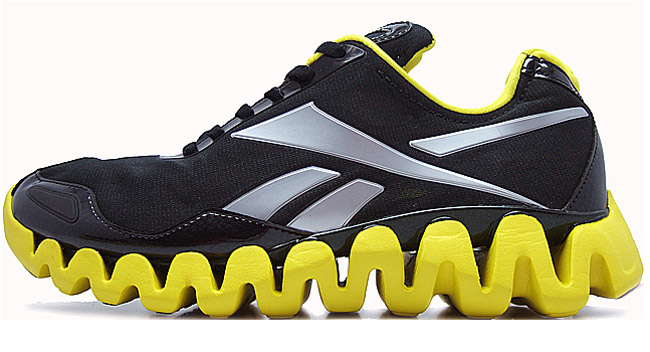
    The shoe already stands out from the crowd due to the rarely shaped foam base

    Solely the design of the ZigTech is very attractive. Compared to other models of running shoes, it catches your eye due to a much different look and shape, rather than regular trainers that we have seen over and over again in the past years. The shoes are very light; no more than 12 ounces (340 grams) each. The true secret of the shoe is actually the zig-zag base from which the name of the shoe derives. The squiggly foam, according to many shaped to resemble a heartbeat monitor, is light and flexible which allows for great amortization and support. The shoes also have a distinct springiness which becomes more and more noticeable as the runner increases his speed. This is because each part of the foam acts independently, allowing for smooth absorption of the impact. In addition, the shoe uses a common Pump Technology that has been known for the past 20 years however its efficiency has been debated by many.

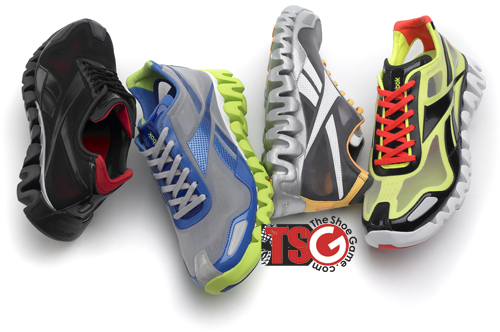
    Other than the advanced base, the shoe has all the characteristics and typical traits of athletic shoes. The toe box, heel cup and the footbed, as experts like to call them, are all areas of the shoe that the ZigTech shares with regular trainers. ZigTech comes in a variety of colors and models but thanks to the Reebok website it is possible to customize your own shoe according to preference.

    Reebok allows complete customization of your shoes

    Benefits behind the Technology

    Reebok’s newest technology implemented in the ZigTech training shoe gives a wide range of benefits to the user:

    1. Upon impact with a surface, energy is sent from heel to toe and up to the body allowing the return of some energy lost during the contact with the ground. Many people have stated that the with each step the shoe feels like it’s accelerating and propelling the user forward.

    2. The ZigTech reduces the tearing and wearing of important leg muscles by up to 20%, at the same time minimizing chances of damage or injury

    3. The stable heel and the soft base provide a strong frame that firmly fits your foot. The shoe is set to rap itself around the foot of the user, fitting it with great precision.

    4. Upon exercising, the flexible foam smoothly reacts with the ground. Each part bends independently to fit the irregularities in the surface, providing an even run.

    5. The shoes have been said to be very breathable which is quite  useful; the feet do not get as sweaty and the ZigTechs are much more comfortable. This trait can also prevent a variety of blisters or burns from forming on your feet, something that can really effect the running form of regular runners.

    The View of the Public

    Like in most cases, different people have different opinions and impressions about a product however the ZigTechs have received a large quantity of positive responses. Many athletes, performing a variety of sports ranging from American football to Formula 1 racing, have been endorsing this new shoe model. Among them has been Martin Fagan, an Irish Olympic Marathoner who has been using and adapting the ZigTechs to his daily workout routine. He pointed out the fact that the shoes allowed him to run longer distances and recover faster after a practice. He enjoyed them so much that he began even wearing them to the gym. Fagan said they feel so comfortable that his other shoes do not feel as good anymore.

    “It took no time at all to realize how soft and comfortable they were-that happened as soon as I put them on”, said Martin during his interview with one of the Runner’s World journalists.

    In general I think that the shoes are a fantastic invention that will greatly enhance and improve the efficiency of the workouts of different athletes. The ZigTech are a tremendous model of training shoes, but nothing more than that. I think in races, whether on low or high competitive levels, they would benefit the user in an unfair and unjust way. Shoes such as these should be used solely for the purpose of training for tournaments were only the skill and ability of the participant matter. Nevertheless, the ZigTechs are shoes that should definitely be checked out during the next visit to one of the Reebok or any other athletic store.

    Sources and More Information:

    http://theshoegame.com/articles/bill-mcinnis-creator-of-zigtech-interview.html

    http://solecollector.com/Sneakers/News/Available-Now-Reebok-ZigTech/

    Runner’s World Magazine November 2010 (US Edition)

    https://defynewyork.wordpress.com/2010/02/25/get-ziggy-with-it-the-reebok-zig-tech-2010/

    http://www.examiner.com/outdoor-recreation-gear-in-national/reebok-zigtech-review

    http://www.reebok.com/US/more/zigtech

    By Adam Dyk

    Class: Design Technology HL 1

    Teacher: Mr. Mark Trumpold

  • The Nike Mercurial Superfly II Elite (in depth analysis)

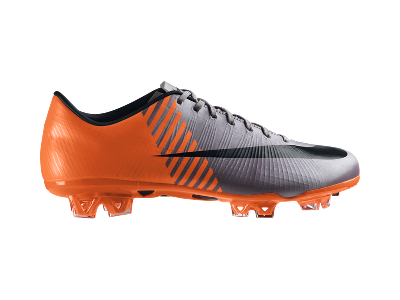
    The Nike Mercurial Vapor Superfly II Elite

    Original Color for Superfly II Elite

    Personal Point of View on the Shoes

    Theses shoes over the past few weeks have left somewhat of a great impression on me. I’ve looked at them, held them and been given a quick trial with these shoes. I have a love hate relationship with these boots from personal experience alone, but completely understand why these are the top and newest shoes on the market right now. I wouldn’t call them the perfect shoe for me, I’ve tried somewhere over 20 football shoes in the past 5 years and I’ve come to learn that all shoes have advantages and disadvantages and depending on the person, the shoe could suit different people in different ways. These shoes from my own knowledge are by far the lightest I’ve ever tried. The lightness of these shoes contributes to why they are so popular, it made me run faster and accelerate quicker, and in a sport which is played so quickly, speed is of a high priority. I personally think that these shoes have been well designed in the aspect of visual attractiveness, because when I walked into the shop they were the first shoes that came into my view. Certainly they are attention grabbers, and being in the middle of the field it’s quite important that my teammates know where I am.

    Nike’s Stated Benefits of the Shoes

    • Flywire for ultra light-weight and support

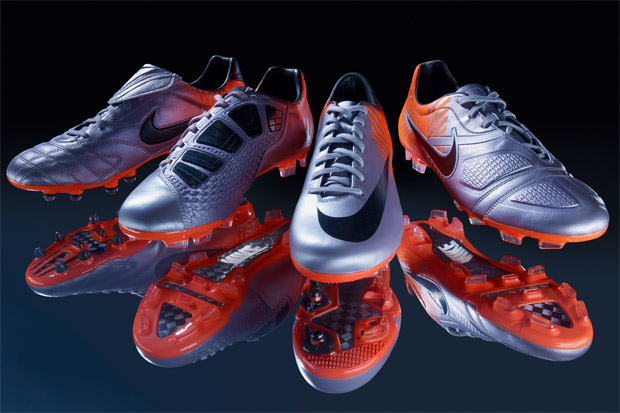
      All four shoes of the Nike Elite series introduced for the Fifa World Cup 2010
    • Revolutionary traction for extra grip
    • Traction pattern for cutting and instant acceleration
    • Includes exclusive shoe bag and box
    • Firm-ground (FG) Bladed and conical cleats for use on short grass fields.

    Nike’s revolutionary traction in Nike’s opinion is the top reason for the shoe’s popularity. The traction in this shoe is

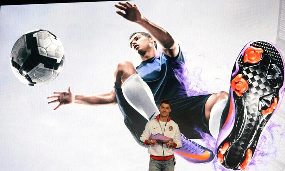
    Cristiano Ronaldo endorsing the new football shoes

    what is called ‘adaptive traction’ that activates a cleat in the forefoot that extends when enough pressure is exerted, it extends when needed for the “relentless grip and acceleration the game demands.” Along with the injected stud, the traction in the vapor allow for effortless acceleration. The shoe also includes toe off traction for instantaneous bursts of speed.

    All fields of the aesthetics and materials were carefully chosen and for specific reasons. The Vapor Superfly II Elite features innovative Flywire. Flywire is made of nylon fibers, these fibers are sturdier than older materials and help hold the foot in position. Another advantage to Flywire is that the mass of the material is a lot lighter than older materials. The Flywire also provides better control of the ball and adjust to the foot a lot better. The most minimizing factor of weight in the unparalleled lightness of these shoes is the carbon-fiber chassis, which makes the shoe lighter but also at the same time maximizes strength. The final major contribution to making these shoes such a success was the perforated sockliner which presents low profile cushioning and support whilst also lessens the cleat stress. The total weight of this pair of shoes is an amazing and currently unmatched 370g (13 oz). This boot is favored by wingers or strikers who feel that speed is the most important asset in their game. As a publicity stunt, Nike got Olympic Gold Medalist sprinter, Asamfa Powell, to run 100 meters in these football shoes and on the first attempt he covered the entire distance of the football field in less than 10 seconds, four tenths of a second slower than the track world record.

    Part of Nike Elite Series

    After spending nearly 2 hours in the store I came to the conclusion they weren’t the shoes for me. Instead I chose the T90 Laser III, also from the same elite series. The new revolutionizing elite series consists of 4 shoes. The first, as I have discussed previously in depth because they have been the biggest success and most sophisticated technology, was the Superfly II. Secondly was the shoes I purchased, based upon personal preference, the T90 Laser III. Thirdly, the Tiempo III, these boots are more intertwined with the classical designs of the previous years, but still incorporates much of the revolutionary technology. The final pair is the CTR360, which is the sturdiest of all the shoes, and as the name of the shoe states it optimizes control of the ball. As I have said before the choice goes down to preference but all these shoes have their given benefits and a choice of any of these would be a choice of a football shoe that has left its mark in revolutionizing the football industry.

    Sources and Further Readings:

    http://store.nike.com/us/en_us/?l=shop,pdp,ctr-inline/cid-1/pid-337913/pgid-301857

    http://www.studs-up.com/2010/08/nike-mercurial-vapor-superfly-2-elite-review/

    http://www.designboom.com/weblog/cat/8/view/9325/nike-mercurial-vapor-superfly-ii.html

    http://www.prodirectsoccer.com/prodinfo.asp?PID=PDS-002-009-C17&DEPT=2&BRAND=9&SS=1&PROFILE=Speed

    By Laurance Townsend

    Class: Design Technology SL I

    Teacher: Mr Mark Trumpold