The Design Technology Blog

Category: Product Design

  • 3D Printing- Food- Saving Lives

    3D printing is a process of making three dimensional solid objects from a digital model, and performed by a materials printer using digital technology. 3D printing has come up with a way to end hunger. 3D printing can end hunger by creating 3D food.

    null

    3D printed food will affect mankind, as it will feed everyone. According to the “contacter”, 3D printing meanms the end of food waste. If ever the worlds population reaches its peak, the people will not be able to live due to hunger. However, due to the 3d printed foods, people will be able to live without hunger. The machines will have powder that is shelf stable for up to 30 years, having all the nutrients.The 3D printing affects the society socialy as not only the rich will be able to never face hunger, but also the poor. The 3D printer will provide the poor with food at a lower price.

    Not only will3D printing help the people from being exposed to hunger, it will also save lives. On May 22nd 2013, a baby was saved by 3D printing from tracheomalacia, which is a diease that causes the windpipe to collapse. After being given the permission the doctors were allowed to use the 3D printed part in order to save the baby.

    This shows a future of advancement in medicine. 3D will help save lives that are suffering. This as said before, will lead to an adfvancement in medicine, and save many lives, moreover, it will make the process of organ donation faster as the patient will not have to wait for an organ donor, instead the organ can be 3D printed.

    In conclusion, 3D printing is an excellent invention, as in the soon future it will be saving lives due to organ donation and prevention of hunger.


    References:

    “3D Printed Medical Device Saves Baby’s Life | Video – Live Science | e! Science News.” e! Science News | Latest science news articles. N.p., n.d. Web. 23 May 2013. http://esciencenews.com/sources/live.science/2013/05/22/3d.printed.medical.device.saves.babys.life.video.
     
    “The Audacious Plan to End Hunger With 3D-Printed Food.” Mashable. N.p., n.d. Web. 23 May 2013. http://mashable.com/2013/05/21/end-hunger-3d-printed-food/.
     
  • Innovative Work- Earphone Alarm

    Earphone Alarm

    The Earphone Alarm, also known as a Anshinkun-2 is a new Japanese gadget that works as a small timer, worn just like an earphone. It’s very light, so it does not cause discomfort, and small so it’s not unattractive, nor does it get in the way. Its’ portable, and runs on batteries so it does not need to be plugged in or charged. This gadget is very useful for multiple things, such as if you’re on a train for example and fall asleep, the timer will go off to wake you up so you don’t miss your stop. Another bonus about the Anshinkun-2 is because it’s in your ear, it won’t disrupt other people, and only you can hear it. Other situations it would be useful in would be if you need to work for a certain amount of time, just set it to go off when you need to stop. It’s handy when cooking because you can time your food and walk around the house or go out and not miss the alarm on the cooker, for example. Another big selling point about it is its waterproof, so you can use in when showering or skiing. It’s manufactured by the Japanese company Honda Tsushin Kogyo, and sells on the market for 11 dollars.

    Though it is a great product, there are also environmental factors to take into consideration. An example of this would be the manufacturing that takes place, the use of the product and the disposal of the packaging and batteries that it needs to function, which are bad for the environment while being made, and if they are not recycled properly. Also, the actual making of the gadget is not environmentally friendly, because like many, if not all factories, the smoke and chemicals released while the product is being made are bad for the atmosphere. When the earphone alarm is actually made, it then has to be shipped to other various countries which will be selling the product. The shipping not only costs money, but the shipment also has to be disposed of once the product is in its designated area, or should be recycled properly which is no guarantee. Then once it has actually reached the destination in which it will be sold, its packaging has to be taken care of properly, or it’ll just be thrown away and regarded as waste. We also should take into consideration what will happen with the actual product or earphone alarm when the buyer has finished with it. It could be recycled for parts, but will most likely just be thrown away.


    Citations-

    – “i-store guide: 10/23/09.” i-store guide. N.p., n.d. Web. 9 Dec. 2012. <http://i-storeguide.blogspot.com/2009_10_23_archive

    – “Coolest New Inventions from Japan: Earphone Alarm – BusinessWeek.” BusinessWeek Slide Shows and Multimedia. N.p., n.d. Web. 9 Dec. 2012. <http://images.businessweek.com/ss/09/09


  • Air-Conditioning

    Adjust the weather just the way you like

    Air-conditioning has affected society in three ways. It affected it environmentally, ethically, and morally. The environment has been affected by air-conditioning as no matter what the whether is like you can adjust it just the way you like. Therefore, if its summer and you are hot you can make your air-condition produce cold air making you colder, and vice versa. Air-conditioning changes whether of the environment, therefore, not making a difference between summer and winter. Air-condition affects morale as it boosts everyone’s morale, for example, if it is hot then people are very stuffy and sweaty and usually in a bad mood, unless they have air-condition which would help them be cool and allow them to be in the perfect weather, moreover, boosting their morale. Even when people sleep they cant sleep either in very cold weather or very hot, that’s why Air-conditioning is needed, cause it will produce the perfect weather allowing them to have a goodnight sleep. How it affects the society ethically is that it comforts us and gives us the exact breeze/weather we want, it controls are temperature. It also makes us not care whether its hot or cold because with air-conditioning we can adjust the weather.

    Refrences:

    “Samsung News :: Air Conditioners.” Mobile Phones | Televisions | Notebooks | Refrigeration – SAMSUNG AU. N.p., n.d. Web. 9 Dec. 2012. <http://samsung.com.au/news/category/home_appliance_news/air_conditioners>.

  • The Telephone

    The Telephone

    Invented in the mid 1870s by Alexander Graham Bell, the telephone revolutionized communication and has brought the world closer together.  Modern telephones have a microphone to speak into, an earphone or speaker that reproduces the voice of the other person, a ringer which makes a sound to alert you when a call is incoming, and a keypad to enter the telephone number of the telephone you are calling. The microphone and earphone are usually built into a handset which is held up to your face to talk. The keypad may be part of the handset or of a base unit to which the handset would be connected. Although originally designed for simple voice communications, most modern telephones have many additional capabilities. They may be able to send and receive text messages, take and display photographs, play music, and surf the Internet. These days’ Smartphone’s also integrate all computing needs.

    Environmental impact of cell phones

    There are 6.7 billion people on this planet and 61 percent have a cell phone subscription, that’s 4.1 billion. The average consumer will use their cell phone for less than a year, during that year it will use 4,221 mega joules of energy, the equivalent of 32 gallons of gas, and emit 112 kilograms of C02. Transferring 1 GB of data over a 3G network will use 939 mega joules of energy, the equivalent of 7.3 gallons of gas, and emit 17kg of C02. An unused but plugged in charger still draws about half a watt. If everyone left their charger plugged in ALLDAY, it would waste enough electricity to power 28,000 homes. 140,000,000 cell phones (4 per second) will end up in landfills this year. Leeching 80,000 lbs of lead into the earth, in that landfill is 4.7 tons of gold worth $56 million and 49 tons of silver worth $8.4 million. For every 515 cell phones recycled, it saves enough energy to power one home for a year. If all these thrown away cell phones were recycled, it would save enough energy to power 272,000 homes. To charge every cell phone in use on earth would require the equivalent of 584,000 gallons of gas and produce 35,000,000 pounds of carbon dioxide, imagine that every day, if we all charged our phones half as often it would be the equivalent of taking a million cars off the road. Although mobile phones only make up a small percentage of the e-waste mountain, manufacturers are aware of the need to address the issue. Leading makers, including Motorola, LG, Sony Ericsson and Philips, have all implemented eco-design aspects into their production lines, including reducing the amount of hazardous substances used in their products. Nokia, the world’s largest mobile phone manufacturer, produces a handset every nine seconds. It has decided to implement requirements set out in the EU Restriction of Hazardous Substances Directive in all 10 of its factories around the globe. The RoHS Directive bans six substances (lead, cadmium, mercury, hexavalent chromium, PBB and PDBE) from products that are either made or sold in the EU.


  • PlayStation Vita

    Many people have heard of Sony’s very successful PlayStation Portable. The product is known to have been the best portable gaming device on the market at the time competing with the Nintendo DS. Although the DS attracted a different market, it’s graphics capabilities did not match that of the PSP at the time of its release. Furthermore, the PSP attracted multiple markets where as the DS did not.
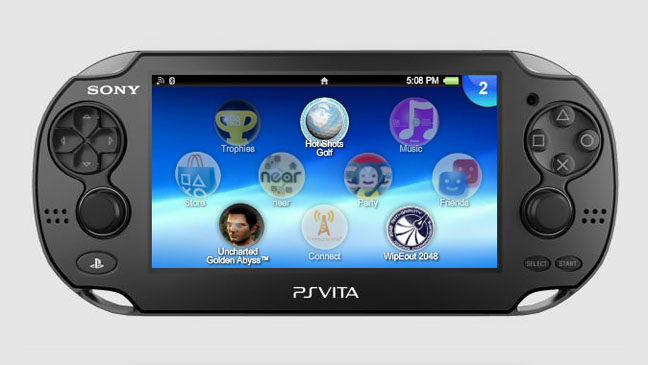
    Since then the Sony PSP has developed into the PSP Go, which sadly was not as a great a success. Issues with how the device stored games and the fairly expensive price led people away from the product. However, Sony has tried to push back from their last market failure with the PS Vita. This new portable gaming console competes with the 3DS and is part of the eighth generation of gaming consoles.

    The PlayStation Vita comes with a number of new functions. For starters, the console has a new multi-touch screen that provides a new style of game play for the user. This 5″ OLED screen happens to be larger than either the PSP or PSP Go and displays approximately over 16 million different colors.
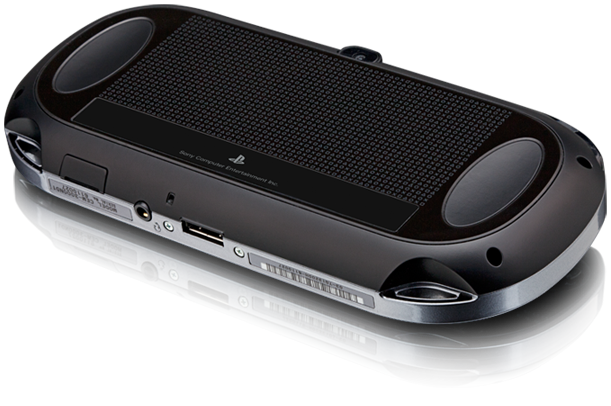
    Of course the idea of touch screen gaming is nothing new (courtesy of Apple), but the PS Vita’s usage of “touch” within game play goes further with the incorporation of a rear touch pad on the back of the console. This touch pad provides the same usage as the front touch screen, but instead of having the user block part of the screen withtheir hand while using the touch pad they may now use the touch pad on the back. This can be very important within intense boss fights and other tricky challenges while in game.

    The original PSP systems used UMD discs to store games, however these disks could only store 1.8 GB of memory. The PSP Go did not have any form of game storage other than digital files, which had to be downloaded from the PlayStation Network store. This bothered gamers a great deal since they could not play their old PSP games on their new PSP Go. Furthermore, the PSN store only sold so many games. However, with the PS Vita came the use of NVG cards to store games. This proprietary flash card format is similar to the Nintendo 3DS game cards. The cards hold initially 2-4 GB of data, which is substantially bigger than that of the prior UMD disks, with plans for bigger cards for bigger games in the future.

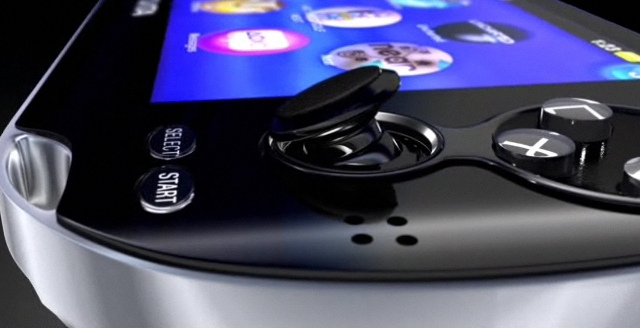
    The console also has front and rear view cameras, which are incorporated with player ranking and other gaming uses. Pictures and videos can also be taken with the two cameras. Furthermore, the PS Vita is the first portable gaming console to have Dual analog sticks. This provides the user with the same control capability as when playing a PS3 or PS2 as well as provides room for game developers to further enhance the game play of games for the user. Such improvements are quite noticeable in first person shooters.
    Cross platforming is also available on the PS Vita. This refers to the ability to play games interchangeably between consoles, such as the PS3 and PS Vita in this case. This allows the user to be play one game on their PS3, pause the game on the PS3, and then continue it on the PS Vita. This function also allows PS Vita users and PS3 users to play against each other online, thus increasing the number of users of gaming servers. This makes it easier for people to connect to matches due to the increased number of people online.

    Six axis motion sensors have also been added to the PS Vita. Six axis motion sensors are known for their use in PS3 controllers. They provide the user with the ability to tilt the console in order to control the game play. This feature is also common in products such as the iPod Touch, but is new to strict portable gaming consoles such as those made by Sony and Nintendo.

    The PS Vita’s starting price is at $249, but there is a second model for $300. This is the PS Vita 3G/Wi-Fi system and is powered by AT&T’s Mobile Broadband Network. On this console, users can receive and post scores and game ranking wherever they are as well as carry on in multiplayer game sessions, and cross game text messaging in parties. A GPS system is also available on the 3G/Wi-Fi models that allows the user to locate and play with friends.
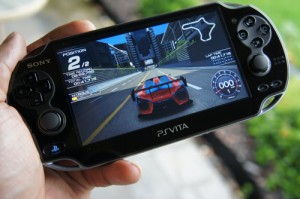
    Sony’s new console has raised the bar for portable gaming and although it’s starting price may seem a little high for a portable console (costing about just the same as a PlayStation 3) it is not for bad reasons. The console brings forward the use of new technology and pushes it to its maximum capabilities. Gamers can only wait to see what fantastic games the console will produce.


    http://us.playstation.com/psvita/features/#psvita-rear-touch

    http://www.techradar.com/reviews/gaming/handheld-consoles/ps-vita-1061138/review

    PSP VS PlayStation Vita Comparison

  • Fiberglass

    Fiberglass is an incredibly versatile material and it comes in several forms. Almost everyone has seen fiberglass insulation and anyone who has touched it will recall the itchy feeling often with a little rash which develops afterwards. This Is because the minute shards of glass cut into the skin and cause irritation.

    The fiberglass used in the automotive industry is different from insulation fiberglass. It usually comes in a mat, tissue or cloth, although a chopped strand mixed with resin is often used for large applications such as boat hulls.

    MATERIALS 

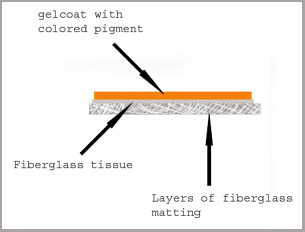
    Gelcoats are the shiny face of fiberglass, gelcoats are what you see on most fiberglass vehicles (which haven’t been painted) or boat hulls. Gelcoats consist of a thick gel-like resin mixed with a colored pigment, it is the first thing laid into a mold and therefore when the mold is removed it becomes the exterior.

    Below is simple diagram showing how many fiberglass bodies are constructed, there are other methods and this is just a common example.


    Tissue
    Fiberglass tissue as the name suggests is a very thin tissue like layer of fiberglass, it is very smooth and porous and the tissue sits underneath the gelcoat. Tissue helps to smooth out the inherent roughness of fiberglass matting, while also adding strength.

    Mat
    Fiberglass matting makes up the bulk of any fiberglass bodied car. Several layers are built up one on top of another until the desired thickness and strength is achieved. This is what you might see if you look at the inside of a fiberglass panel.

    Cloth
    Fiberglass cloth is strong and is often used where it may be visible and therefore aesthetics are important. One of the downsides of fiberglass cloth is that because the strands are neatly woven the layers do not intermesh like they do with the disorganised and loose strands on the fiberglass mat. Therefore the layers of cloth sit on top of one another, rather than meshing together like the fiberglass mat.

    Resin and Hardener
    Without resin the fiberglass itself would be useless for building anything requiring rigidity. Resin is mixed with a catalyst before application to the fiberglass. The drying process involves a chemical reaction which has several variables including, the amount of catalyst, temperature, humidity, and any water present in the fiberglass resin (water shouldn’t be there!).

    End result
    The results which can be achieved with fiberglass are quite impressive. Once fully hardened and sealed with resin or a gelcoat fiberglass is waterproof, relatively light weight and when done properly it is extremely strong. It is reasonably inexpensive when compared to the alternatives, in short it is an ideal material for the automotive field.

    http://www.fiberglasswarehouse.com/index.php

    http://www.inlinefiberglass.com/

    http://www.uscomposites.com/cloth.html


  • Planned Obsolescence: Cars

    Definition:

    “Planned obsolescence, or built-in obsolescence if you are in the UK, is the decision by a manufacturer to purposely design, manufacture and distribute a consumer product to become obsolete or non-functional specifically to force the customer to buy the next generation of the product.” (http://www.computerinfoweb.com/computer_electronics/Blu_Ray.php)

    Product: Cars

    A prevalent example of planned obsolescence in a product design is found in that of cars.

    Planned obsolecence in cars is a relatively new thing. In the sixties, cars that were manufactured before WWII were still driven, and during that time Volkswagen built a cheap and practical car “until it flooded the entire market”. However, companies realized that once sales stabilized, people would not buy new cars. For the manufacturers, this meant firing many workers and a drop in profits. Thus, for the next two or three decades they adopted the process of keeping manufacturers and workers busy and producing cars that would not last for a long period of time. Why? To keep customers buying new cars.

    The policy (regarding the production of cars):

    1. “routinely discontinue parts that could otherwise be made available for repairs.”

    2. ” confirm to a strict yearly cycle of model releases, often introducing purely cosmetic changes from one year to the next.”

    3. “retire popular models and bring out something new every few years, making it harder to fix older vehicles.” (instead of “sticking with hits and standardizing   them over time, which would better support a repair aftermarket”)


    Cars today, for many, are seen as a fashion accessory and statement. It has become common for people to buy the new model of a car, even if the one they own is in great shape, and still has years to live.

    Although planned obsolecence is beneficial for car companies, as it greatly increases their profits and product demand, one must consider the ethical implications of this policy. Is it ethically acceptable to produce cars that will not last very long in order to make a greater profit?


    Sources:

    http://www.canadafreepress.com/index.php/article/11010

    http://www.thedailygreen.com/environmental-news/latest/planned-obsolescence-460210#ixzz1th7oPId5


    ...

    http://pinterest.com/pin/268104984036388056/

  • Planned Obsolescence

    Planned Obsolescence is when a product is designed to become obsolete rapidly with the release of a new model of the product or a completely new product all together. Companies that use this design technique will usually have a set date of when the product they just released will become obsolete and have a newer and better model already made. This technique and the idea that newer is better is what causes people to constantly upgrade and buy new products. It keeps the market moving which effects the wallet of the consumer but planned obsolescence also effects the environment.

    Products designed for obsolescence tend to be made with a more green design as they are meant to be thrown out. The product also tends to be less durable as the product isn’t supposed to last long anyways. manufacturing the product is also made as cheap as possible sacrificing quality. All of this effects the environment in its own way, factories and plants give off a lot of pollution to make these products faster and cheaper. Products are made with different materials which have to be obtained in different ways which are usually harmful to the environment even though they may be green materials. Finally the lack of durability means that the product will break easily and be thrown away contributing to landfills.

  • Wireless power

    A few years ago there was a demonstration by a team at Fulton Innovation of a product called eCoupled. Using the principle of electromagnetic induction, by which an electrical charge can be stimulated in a wire coil by placing another one nearby, the crazy boffins were able to display wireless power transfer.

    Despite being high voltage, they said, it was safe, efficient and could be applied to any surface. The demo room consisted of a kitchen without plugs, but full of lights that could be stuck anywhere and a frying pan that heated up just by sitting it on the counter. Put a phone on the same counter and it began charging. Clearly, this was the future.


    wireless power


    Fulton are still working on wireless power, but it’s a different company that’s beat it to the shops, Powermat – and its products are expensive for something that replaces a 50p mains plug.

    The Wireless Power Consortium are going to be finalising a standard for wireless power called Qi later this year, which should mean prices drop and manufacturers have the confidence to build the technology straight into devices, rather than requiring an adaptor.

    Another similar technology is the  Airnergy by RCA. It’s a tiny dongle that can turn Wi-Fi signals back into electricity for charging phone batteries and the like.

  • Organic or Genetically Modified?

    Genetically modified food are foods that are derived from genetically modified organisms; products that contain specific changes to their original DNA. Organic products do not contain any genetic modifications. They are foods that are produced naturally without modern enhanced plantation methods such as the wide spread use of pesticides and chemical fertilizers. A lot of controversy exists over the use of genetically modified products and over the years many people have returned to the fruits and vegetables that are produced using organic means. But what truly are the dangers associated with modifying food? Perhaps it has more benefits than weaknesses?

    The Old and the Healthy

    Organic food has always been thought to be the healthier alternative. Various pesticides have been identified by the EPA as cancer causing and dangerous for humans.  Organic products restrain from using such chemicals and as a result provide for a healthier lifestyle. Vegetables and fruits that are grown organically are able to sustain many of their natural nutritious values from minerals, vitamins and anti-oxidants. In the end, the toxic chemicals are not put out into our natural environment. Organic farming allows people to sustain harmony with the world we live in. Keeping our environment as it is is essential for its survival. But contrasting such benefits of an organic production are several negative sides to the whole “story”. Organic products are generally inefficiently produced and at a much slower rate than genetically modified ones.  Such inefficiency leads to increased costs of the organic crops and makes them more unattractive to the local customers. Such foods also have a shorter self-life. Genetically modified crops can last much longer after the harvest than organic foods.

    Leaps in Technology seem attractive

    Genetically modified foods however also pose as an attractive alternative. Farmers are able to grow crops that are resistant to pretty much everything. The local pests and rodents no longer pose any harm. Weeds need not be picked as they are tolerated by the crop. Different forms of bacteria or fungus can do nothing. Extreme environmental changes can be accepted by the crop without majorly affecting its quality. Whether it’s a drought or cold winter, the plant can continue growing. It is important however to keep in mind that genetically modified products do have a negative impact on the environment. Altering the natural existence of organisms (changing the DNA composition) can never have a positive result on the  surrounding ecosystem. The chemicals and pesticides kill and pollute the local plants and may also negatively affect the human digestive system.  It inevitably causes us to question what we are truly eating. Genetic engineering can truly alter a particular crop into something different.

    So…

    Whether organic or genetically modified, both routs have their benefits and disadvantages. However I believe that the question we need to ask ourselves is what we are trying to achieve. I reason that we are trying to receive a product that is of the best quality possible. The cost in most cases is irrelevant. We are entering a new era that promotes a sustainable lifestyle. Organic products are therefore a much better solution for all. They are a healthier choice for the us and our planet.

    Sources of Information

    http://en.wikipedia.org/wiki/Genetically_modified_food

    http://www.thcarson.co.uk/whyorganic.htm

    http://www.csa.com/discoveryguides/gmfood/overview.php

    http://carthageagriculture.pbworks.com/w/page/15315791/Organic%20Farming%20Days%2024

    http://foodandorganic.com/disadvantages-of-organic-food.html

    http://wanttoknowit.com/disadvantages-of-genetically-modified-food/