A few years ago there was a demonstration by a team at Fulton Innovation of a product called eCoupled. Using the principle of electromagnetic induction, by which an electrical charge can be stimulated in a wire coil by placing another one nearby, the crazy boffins were able to display wireless power transfer.
Despite being high voltage, they said, it was safe, efficient and could be applied to any surface. The demo room consisted of a kitchen without plugs, but full of lights that could be stuck anywhere and a frying pan that heated up just by sitting it on the counter. Put a phone on the same counter and it began charging. Clearly, this was the future.
Fulton are still working on wireless power, but it’s a different company that’s beat it to the shops, Powermat – and its products are expensive for something that replaces a 50p mains plug.
The Wireless Power Consortium are going to be finalising a standard for wireless power called Qi later this year, which should mean prices drop and manufacturers have the confidence to build the technology straight into devices, rather than requiring an adaptor.
Another similar technology is the Airnergy by RCA. It’s a tiny dongle that can turn Wi-Fi signals back into electricity for charging phone batteries and the like.
“Mahanakhon will be the most ambitious complex of contemporary architecture and design in Thailand and the tallest building in Bangkok.” – Ole Scheeran
This great modern architectural building, which began construction in the Fall of 2009, is said to be one of the best designs in the world. The Mahanakhon Bangkok Tower designed by German architectOle Scheerenis planned to be the tallest construction in Bangkok, Thailand. Ole Scheeren has unveiled plans for The Tower of Mahanakhon, a 77-story skyscraper. The building is due to be completed by 2012. The Architectural Design
The complex will be 150,000 square meters (approximately 1,6 million square feet) and is a series of components that comprise the new Mahanakhon square, which will be a landscaped outdoor public plaza. With distinctive sculptural appearance, Mahanakhon has been carefully carved to introduce a three dimensional ribbon of architectural ‘pixels’ that circle the tower’s full height, as if excavating portions of the elegant glass curtain wall to reveal the inner life of the building. The design has been created with purpose of revealing life inside the tower. On the other hand, the building has been following and taking security protocol into great consideration in order to ensure the successful construction of the project. The building will include luxury retail and dining areas. Its glittering stacked surfaces, terraces and protrusions will simultaneously create the impression of digital pixilation and echo the irregularity of ancient mountain topography. This architectural geography is conceived to convey the energy, intensity and inclusiveness of Thai society and celebrate Bangkok’s emergence as a true global capital, fitting the Thai meaning of the name Mahanakhon, translated as ‘great metropolis’. The building plans to also feature an adjacent freestanding 7-storey building known as The Cube, which will offer multi-level indoor and outdoor terraces. This provides a network of social spaces with an extensive and carefully selected mix of dining and leisure facilities.
A close up of the tower
Inside Manakhanon
The new project is intended as a novel public destination within the city. Manakhanon will include luxury retail space with lush gardens and terraces, a major transportation hub, and a five-star hotel designed by Ian Schrager. It will have multiple levels of restaurants, cafes and a 24 hour marketplace. It also plans on including Ritz-Carlton residences. Each residence is offering the atmosphere of a sky box penthouse. The project is working in collaboration with Marriott International and renowned hotelier Ian Schrager.
More about the Project
“MahaNakhon will be the city’s tallest building, but more significantly it will
accurately represent the audacity of Bangkok today – the optimism and strength ofThai culture and the value of that culture to Asia and the rest of the world.” –Sorapoj Techakraisri, CEO of PACE Development.
Homes available at Mahanakhon will range in size from 125 square meters (1,350 square feet) to 830 square meters (8,930 square feet) with ceilings up to 3.5 meters high (approximately 11.5 feet).
Prices for the residences range from $840,000 USD.
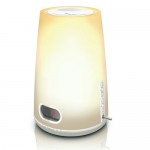
Philips brought out the wake up light around 2008. This light is a new form of alarm clock.
The light will simulate a sunrise and give the person a pleasant way of waking up, this is because of a natural reaction the user will have towards the sun rise. Nature’s alarm clock is the sun rise and in the past (before technology) people would rely solely on the sun, they go to bed once the sun sets and wake up when it rises. This lamp uses this natural reaction to wake you up very pleasantly.
The theory behind it is that when the sun rises your body slowly prepares you to wake up by creating fewer hormones which make you sleep (adenosine and melatonin) and will be breaking down the melatonin and adenosine to wake you up again.
The product was tested in different parts of the world especially where it is dark such as Norway during the winter. After about 6 weeks 98% of the citizens who tested the product wanted to continue. Links 4 and 5 show the results of 60 days as well as after two, four and six weeks.
The price can range from 109€ to 129€ this is a lot of money but I believe it will make a large difference when used. There are also models where there is an iPod/ iPhone charger dock attached to the light to play your music while using the light.
The bass guitar, or electric bass or bass, is a stringed instrument that is primarily played with the fingers, thumbs, or using a pick. The thumb is used by plucking, slapping, popping, tapping, or thumping. The bass guitar has a similar design to that of the electric guitar. The bass has a longer neck and scale length (length of the strings). Also, basses can come with four, five, or six strings, the four-string bass being the most commonly used. The four string bass is tuned the same as the double bass. The bass is commonly used for keeping the beat of a song and is used in most styles of music.
Design Consideration
The body of a bass is usually made out of wood, but other materials including graphite have been used before. Many different types of wood may be used to make the body, neck, and fretboard of a bass. However, the most common type of wood used for the body of a bass is alder. For the neck, maple wood is commonly used and for the fretboard, rosewood is preferred. Mahogany, maple, ash, and poplar are other commonly used woods for the body of the bass. Mahogany for the neck is also used and maple or ebony for the fretboard.
Handmade instruments by highly skilled luthiers (stringed instrument makers) are becoming more and more available. These lutheirs use exotic materials when making basses, such as the woods bubinga, wenge, ovangkol, ebony, and goncalo alves. Graphite composites are used to make lightweight necks, in some cases. Exotic woods are used in more expensive instruments. For example, Alembic (a bass and guitar making company) uses cocobolo as a body or top layer material because of its attractive grain. Warwick bass guitars are also known for having exotic hardwoods. Most of the necks are made of ovankol and the fingerboards are made of wenge or ebony. Solid bubinga bodies are used for tonal and aesthetic qualities.
Strings
The standard design for the bass guitar has four strings, tuned to E, A, D, and G. These are in fourths meaning that the open highest string, G, is an eleventh (an octave and a fourth) below middle C. This makes the tuning of all four strings the same as that of the double bass. Tuning is the same on the lower strings of a five or six stringed guitar.
Strings types include all-metal strings and strings with different coverings. All-metal strings include roundwound, flatwound, halfwound, found wound, and pressure wound. Two examples of different string coverings include tapewound and plastic-coatings. This variety of materials used in strings allows bass players to have a range of tonal options. In the 1950s and early 1960s, the most commonly used string used by bassists was flatwound strings with a smooth surface. These strings had a smooth, damped sound similar to that of a double bass. In the late 1960s and 1970s, roundwound bass strings became popular, but flatwounds continued to stay popular as well. These roundwound strings were similar to those of guitar strings at the time. Comparing the two string types, roundwounds have a brighter timber (quality of a musical note) with greater sustain (amount of time it takes for the sound of the string to become silent) than that of flatwounds.
Throughout the history of football, people have been searching year after year for the perfect ball. It has been a quest to improve and improve a ball that is used in the most widespread sport in the world. World Cup after World Cup has seen new footballs with incremental changes in material between each one. In 1836, Charles Goodyear patented vulcanized rubber, he spent nearly 20 years in attempting to create a ball for football and finally he invented the first vulcanized rubber football in 1855. In 1862, H.J. Lindon developed one of the first inflatable rubber bladders for balls. “By the 1900’s bladders were made with stronger rubber and could withstand heavier pressure. Most balls produced by that time used rubber bladders. The balls were made from inner tubes covered with heavy brown leather. These balls would bounce easier and yet could be kicked. Most balls had a tanned leather cover with eighteen sections stitched together arranged in six panels of three strips each.” (soccerballworld.com). Throughout the next 70 years, leather balls were the only ones in the game and then in the 1970 world cup in Mexico, a revolutionary ball was introduced to the 32-Panel Adidas Telstar ball.
The 2006 World Cup Ball, Teamgeist Ball
This football was made from synthetic leather patches sewn together in a design based on the ‘Buckminster Ball’ or known as the Buckyball. For the next 36 years Footballs were made in this style with minimal change. In 2006, the Teamgeist. The introduction of a 14-panel construction method means that the number of three-panel touch points is reduced by 60% (60 to 24) and the total length of the panel lines falls by over 15% (400.5 cm to 339.3 cm). Building on the introduction of thermal bonding technology in 2004.
Introduction Of Jabulani
The ball is made from eight spherically molded panels and has a textured surface intended to improve aerodynamics. Nevertheless, the ball received extensive criticism from players and coaches before and during the World Cup who said that the path of the ball through the air was unpredictable.
“The ball was constructed using a new design, consisting of eight (down from 14 in the last World Cup) thermally bonded, three-dimensional panels.
The 2010 World Cup Ball, Jabulani
These then are spherically molded from ethylene-vinyl acetate (EVA) and thermoplastic polyurethanes (TPU). The surface of the ball was textured with grooves, a technology developed by Adidas called “Grip ‘n’ Groove” that is intended to improve the ball’s aerodynamics. The design has received considerable academic input, being developed in partnership with researchers from Loughborough University, United Kingdom.” (Wikipedia). This table shows that the moulding technique means the ball retains its shape, and the lack of seaming means there is essentially zero water retention, which will reduce sluggishness of the ball.
Personal Experience
Through personal experiences I have been able to conclude that the unpredictability of the ball is both a good and a bad thing. As the unexpected behavior can trick a goal keeper, whilst at the same time, the speed makes control of the ball quite difficult.
Glass recycling is the process of transforming glass waste into reusable material and substances. Due to the fact that glass retains its original color even after being recycled, recyclers categorize the glass into groups according to color, resistance, strength, and hardness. Bottles, broken glass objects, light bulbs, etc. are all common waste products from households around the world. Glass products and materials are thrown in the trash every day and in many areas, never used again. Every metric ton of waste glass recycled into new items saves 315 additional kilograms of carbon dioxide from being released into the environment during the production of new glass.
Process of Recycling Glass
Glass is mostly composed of three main ingredients- silica sand, limestone, and soda ash. When glass is crushed during the recycling process, it returns back to its natural state. While being in this state, the glass is non-toxic and inert meaning it cannot contaminate the environment. Unlike other materials, glass is 100% recyclable making it one of the most recycled material around the world. The crushed recycled glassed, known as cullet, is then mixed with virgin raw materials (soda ash, limestone etc.)
Recycled Glass applied into Modern Businesses
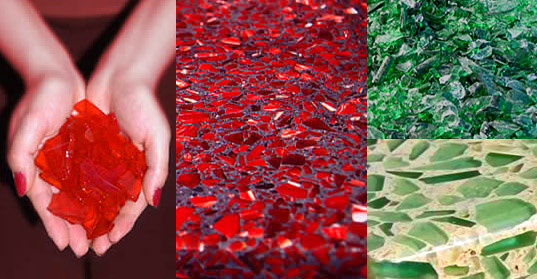
As the green design initiative becomes more and more popular and encouraged, ec0-friendly regulations are implemented into the creation of products in present-day businesses and firms. Vetrazzo Furniture is known for its glass recycled surfaces. 85% of Vetrazzo’s products are manufactured out of recycled glass. Most of the glass comes from curbside recycling programs. Other glass comes from used windows, dinnerware, windshields, stained glass, laboratory glass, reclaimed glass from building demolition, and others. Vetrazzo was awarded a significant grant by California‘s Department of Conservation, Division of Recycling, to help expand the Vetrazzo product line as well as aid them in increasing product capacity.
New materials for car bodies may soon transform the auto industry. Auto engineers can mold these carbon-fiber-reinforced plastics into virtually any shape. The materials are both strong and light which increasies fuel efficiency and safety at the same time. Cars built entirely out of plastic could be the wave of the future, making metal a thing of the past when it comes to cars.
New, innovative cars made almost entirely of plastic are paving the way for what you may be driving in the future.
A mechanical engineer at Porsche Engineering Services in Troy, Mich., says, “With plastics you can design cars which are very bold, and that gives you an advantage to sell nicer cars.”
Plastics have gained a lot of ground over traditional metals used in cars, making it possible to build almost an entire vehicle completely of non-metal material.
Mechanical engineers use a lightweight, high-strength aerospace material called carbon-fiber-reinforced plastic. It’s used in the doors, hoods, fenders, chasis and also in support frames for the engine and transmission. You can mold the plastics into very complicated shapes that maybe you can’t do in steel, plastics help cars lose weight to go farther on fuel.
New materials, like plastic, are usually tested on high-end vehicles first. Once the materials are proven to be more efficient and cost effective, they eventually filter down to affordable consumer vehicles.
BACKGROUND:
Student designers at the College for Creative Studies are creating new plastic polymer materials as alternatives for automobile elements typically made of steel. The designs were part of a semester-long project and the automotive division of the Society of Plastics Engineers.
ADVANTAGES:
Among other advantages, plastics can significantly reduce the weight of a vehicle, improving fuel efficiency by reducing drag, and also cutting down on emissions. Because plastic can be more easily molded, components can be tailored for more comfortable human-ergonomic features, as well as more streamlined, aerodynamic shapes. Less material can be used than with steel components and the durability of plastics results in a longer, more reliable vehicle lifetime.
The “Hotel de Glace” was built in 2000 and is the only ice hotel in North America. It first opened its doors in 2001 and has been immensely successful from its very first season until present-day. By 2009, more than half a million of people had visited the hotel even for just one night in order to experience this unique opportunity. The hotel consists of 36 rooms. With its very own ice chapel, many couples have come to this hotel to get married. The interior temperature remains between -3 and -5 degrees Celsius.
How it was built
Photography by Ahmad Tawakol. Lounge in hotel
The Ice Hotel was constructed using 500 tons of ice and 15,000 tons of snow to craft the Ice Hotel with its ceilings as high as 18 feet. The walls are up to four feet thick and are covered with original artwork and furniture carved from ice blocks. The hotel has a four-month lifespan each year before being brought down in April. Therefore, the hotel usually opens from the first week of January until the last week of March. It only took about a month and a half to build this hotel
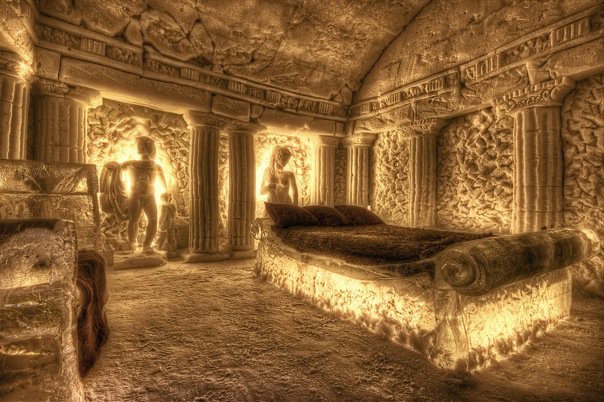
with only 60 workers. The Hotel makes its own snow using a special mixture to adjust the humidity. It is built with metal frames in order to allow the snow to harden for a few days and then the cranes are removed. Each new season, the design of the hotel is altered with the placement of huge new ice statues and an evident change in the hotel’s design. For example, in the 2003 season, the theme of the hotel was fusion. However, in the 2008 season, the style was transformed to an antique-ish style as shown in the image on the left. Therefore, the architecture of the hotel changes regularly.
Life in the Hotel
Photograph taken by Ahmad Tawakol. One of the Guest Bedroo
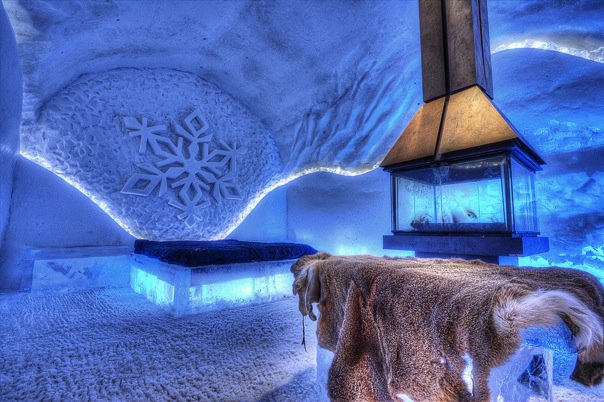
The furniture of the hotel is all made out of ice. To be able to sit or lie down on these pieces of furniture, deer skin fur are always available in the rooms.
Photography by Ahmad Tawakol. Left section of reception area
All beds have a solid ice base and a wooden bed spring with a mattress on top. The sleeping bags guarantee warmth since they they are covered in deer furs from the inside of the sleeping bag. Only the bathrooms are heated and located in a separate insulated structure.
In windsurfing there are many types of sails to enhance speed and or maneuverability. These are many types of sails called free style, wave, freeride, stand-up/ paddle board, freemove, beginners, children, slalom, and lastly the race sail.
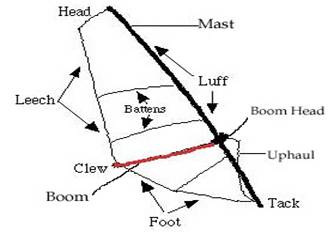
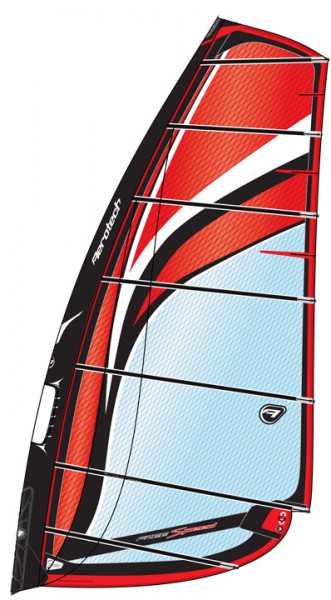
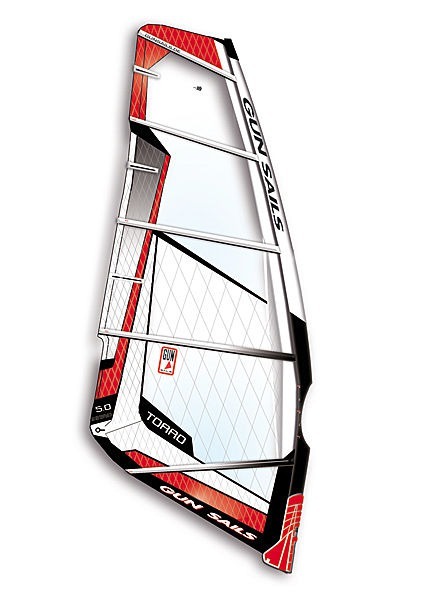
The difference between these sails all depends on the design. The main aspects of the design are the material, the size, weight, the boom, the chambers, and the leech (see image). The three most common materials used for a windsurfing sail are Dacron (woven polyester), Mylar, and Monofilm. Dacron is used in the beginner’s sails, it is lightweight, cheap, but it can outstretch after over use. Mylar is actually a coated form of Dacron, it holds its shape better but it takes part in delaminationovertime. To strengthen areas of the sail they use Kevlar mesh.
A freeride (speed) sail
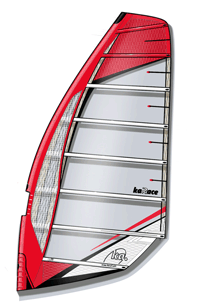
Camber (the straight lines accross a sail)
The difference between speed, freestyle and wave sails is the design of course. In a speed sail there are more chambers to maximize the shape of the sail. These cambers lock the shape to increase the amount of wind that can be captured to increase speed.
A freestyle sail has cambers that are at a greater angle compared to a speed sail. Also there are less cambers since freestyle sails needs maneuverability and quick turns, more cambers will increase the difficulty of the turns which is not needed in a freestyle sail.
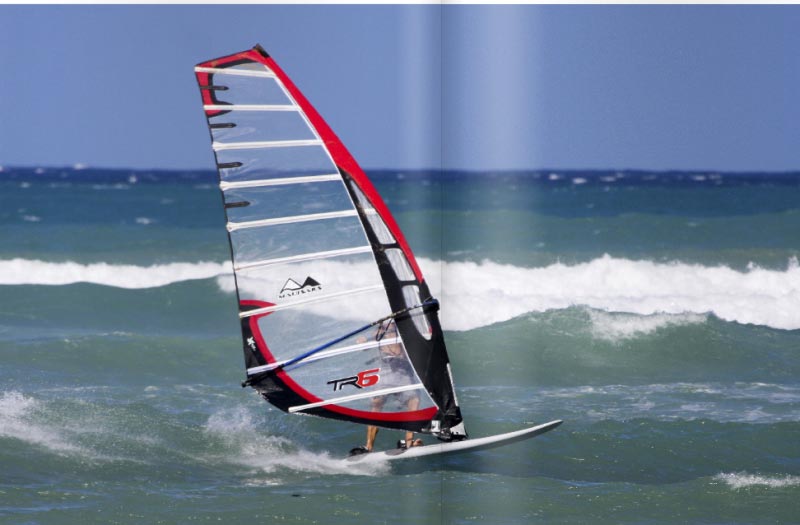
Wave sails are made of stronger materials that can handle a beating if something goes wrong. Wave sails are made to easily change directions and have a good handling. Also, wave sails have fewer cambers to increase handling, but not loose speed. Another design difference is the end (rear) of a sail, for speed the sails extend out and down further than wave sails, because wave sails cannot get caught in the waves.
A wave sail
Notice how the rear is cut higher and shorter than that of the speed sail.
A freestyle sail
A combination of both a speed and wave sail.
Personally I sail with freestyle sails but I do want to try speed and wave sails. There are many different sizes to fit the person who sails them (this affects weight), I can handle a 4.5m^2 which is about twice my size.
Haven’t you ever wanted to run longer but was too exhausted to continue? Maybe you were suffering muscle pains after a hard workout and was forced to skip the following day’s practice? Whatever the reason or excuse you might have came up with the new ZigTech shoes made by Reebok will make sure you will never miss a day or practice ever again. The new advanced technology put into the creation of these new series of shoes is revolutionary and one of a kind.
Design and Unique Structure
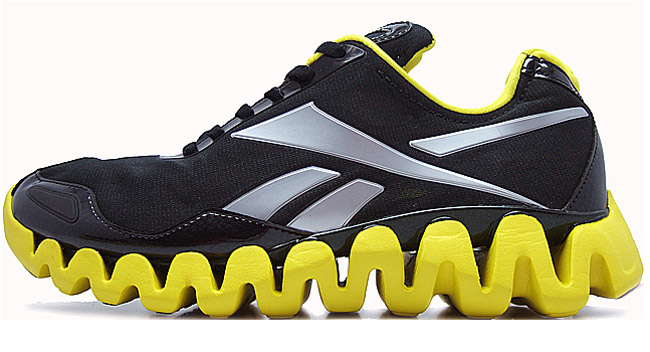
The shoe already stands out from the crowd due to the rarely shaped foam base
Solely the design of the ZigTech is very attractive. Compared to other models of running shoes, it catches your eye due to a much different look and shape, rather than regular trainers that we have seen over and over again in the past years. The shoes are very light; no more than 12 ounces (340 grams) each. The true secret of the shoe is actually the zig-zag base from which the name of the shoe derives. The squiggly foam, according to many shaped to resemble a heartbeat monitor, is light and flexible which allows for great amortization and support. The shoes also have a distinct springiness which becomes more and more noticeable as the runner increases his speed. This is because each part of the foam acts independently, allowing for smooth absorption of the impact. In addition, the shoe uses a common Pump Technology that has been known for the past 20 years however its efficiency has been debated by many.
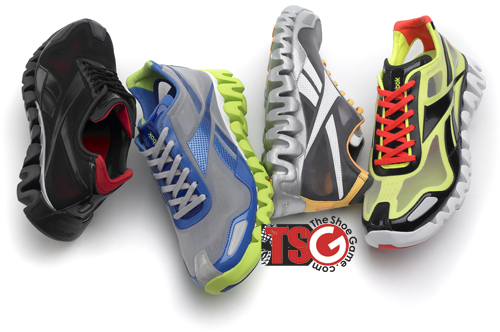
Other than the advanced base, the shoe has all the characteristics and typical traits of athletic shoes. The toe box, heel cup and the footbed, as experts like to call them, are all areas of the shoe that the ZigTech shares with regular trainers. ZigTech comes in a variety of colors and models but thanks to the Reebok website it is possible to customize your own shoe according to preference.
Reebok allows complete customization of your shoes
Benefits behind the Technology
Reebok’s newest technology implemented in the ZigTech training shoe gives a wide range of benefits to the user:
1. Upon impact with a surface, energy is sent from heel to toe and up to the body allowing the return of some energy lost during the contact with the ground. Many people have stated that the with each step the shoe feels like it’s accelerating and propelling the user forward.
2. The ZigTech reduces the tearing and wearing of important leg muscles by up to 20%, at the same time minimizing chances of damage or injury
3. The stable heel and the soft base provide a strong frame that firmly fits your foot. The shoe is set to rap itself around the foot of the user, fitting it with great precision.
4. Upon exercising, the flexible foam smoothly reacts with the ground. Each part bends independently to fit the irregularities in the surface, providing an even run.
5. The shoes have been said to be very breathable which is quite useful; the feet do not get as sweaty and the ZigTechs are much more comfortable. This trait can also prevent a variety of blisters or burns from forming on your feet, something that can really effect the running form of regular runners.
The View of the Public
Like in most cases, different people have different opinions and impressions about a product however the ZigTechs have received a large quantity of positive responses. Many athletes, performing a variety of sports ranging from American football to Formula 1 racing, have been endorsing this new shoe model. Among them has been Martin Fagan, an Irish Olympic Marathoner who has been using and adapting the ZigTechs to his daily workout routine. He pointed out the fact that the shoes allowed him to run longer distances and recover faster after a practice. He enjoyed them so much that he began even wearing them to the gym. Fagan said they feel so comfortable that his other shoes do not feel as good anymore.
“It took no time at all to realize how soft and comfortable they were-that happened as soon as I put them on”, said Martin during his interview with one of the Runner’s World journalists.
In general I think that the shoes are a fantastic invention that will greatly enhance and improve the efficiency of the workouts of different athletes. The ZigTech are a tremendous model of training shoes, but nothing more than that. I think in races, whether on low or high competitive levels, they would benefit the user in an unfair and unjust way. Shoes such as these should be used solely for the purpose of training for tournaments were only the skill and ability of the participant matter. Nevertheless, the ZigTechs are shoes that should definitely be checked out during the next visit to one of the Reebok or any other athletic store.


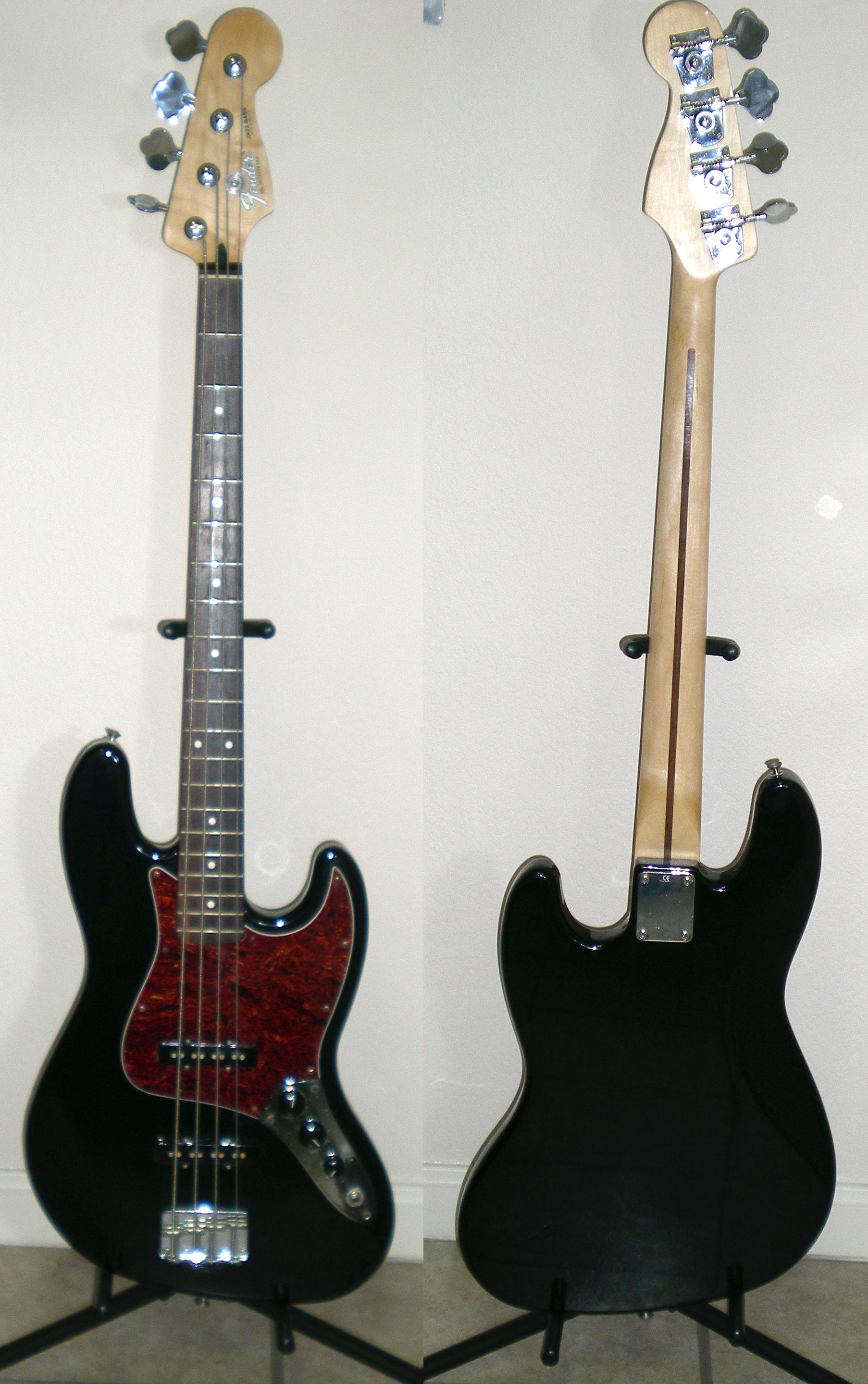
 The body of a bass is usually made out of wood, but other materials including graphite have been used before. Many different types of wood may be used to make the body, neck, and fretboard of a bass. However, the most common type of wood used for the body of a bass is alder. For the neck, maple wood is commonly used and for the fretboard, rosewood is preferred. Mahogany, maple, ash, and poplar are other commonly used woods for the body of the bass. Mahogany for the neck is also used and maple or ebony for the fretboard.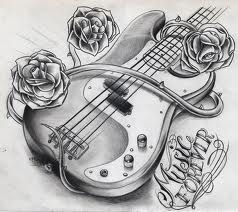
 Strings types include all-metal strings and strings with different coverings. All-metal strings include roundwound, flatwound, halfwound, found wound, and pressure wound. Two examples of different string coverings include tapewound and plastic-coatings. This variety of materials used in strings allows bass players to have a range of tonal options. In the 1950s and early 1960s, the most commonly used string used by bassists was flatwound strings with a smooth surface. These strings had a smooth, damped sound similar to that of a double bass. In the late 1960s and 1970s, roundwound bass strings became popular, but flatwounds continued to stay popular as well. These roundwound strings were similar to those of guitar strings at the time. Comparing the two string types, roundwounds have a brighter timber (quality of a musical note) with greater sustain (amount of time it takes for the sound of the string to become silent) than that of flatwounds.
 otal length of the panel lines falls by over 15% (400.5 cm to 339.3 cm). Building on the introduction of thermal bonding technology in 2004.

 Sources Cited: