3D printing is a porcess in which a three-dimensional solid object is made from a digital model. It is differentiated from most typical machining techniques that depend on the process of removing materials by cutting or drilling. It uses a digital technology that works for prototyping as well as distributed manufacturing in fields like industrial design, architecture, engineering and construction (AEC), automotive, aerospace, dental and medical industries, education, geographic information systems and civil engineering.
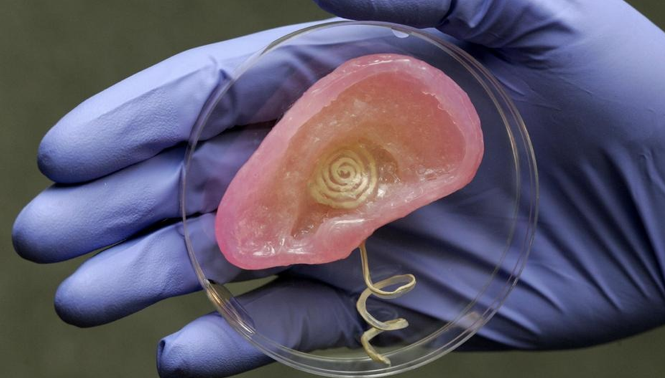
Scientists at Princeton University have used 3D printing to design a bionic ear that can hear better than a normal human ear can. The printed ear intertwines embedded electronics, as the Princeton researchers 3D-printed nano particles and cells and combined cartilage with a small coil antenna to produce the bionic ear.
The ear ended up hearing radio frequencies a million times higher than the average human ear. Lead researcher and assistant professor of mechanical and aerospace engineering at Princeton Michael McAlpine reported that “the way that our ear hears now is we pick up acoustic signals and then we convert those into electrical signals that go to our brain. What this ear does is it has this electronic coil on it and it picks up electronic signals directly.” The research team wanted to ask the question of whether it would be possible to grow an organ in a petri dish with intertwined electronics as the organ developed. The successful bionic ear was made using a $1,000 3D printer to print the cells and electronics. Then, the ear was placed in a petri dish to allow the cells culture for 10 weeks into cartilage tissue.
Professor McAlpine said that his team did not create the bionic ear to help the deaf or those without ears, but rather “The idea of this was: can you take a normal, healthy, average human and give them superpower that they wouldn’t normally have?”
Works Cited:
“3D printing – Wikipedia, the free encyclopedia.” Wikipedia, the free encyclopedia. N.p., n.d. Web. 22 May 2013. <http://en.wikipedia.org/wiki/3D_printing>.
Ramachandran, Vignesh. “3D-Printed ‘Bionic’ Ear Can Hear Beyond Human Ability.” Mashable. N.p., n.d. Web. 22 May 2013. <http://mashable.com/2013/05/24/3d-printed-ear-princeton/>.