Temperature responsive polymers are polymers that exhibit a drastic and discontinuous change of their physical properties with temperature. The term is commonly used when the concerned property is the solubility in a given solvent but may also be used when other properties are affected. Thermoresponsive polymers belong to the class of stimuli responsive materials that are different from temperature sensitive materials whih change their properties continuously with environmental conditions. This polymers display a miscibility gap in their temperatue composition diagram. Depending on whether the miscibility gap is found at low or high temperatures, an upper or lower critical solution temperature exists, respectively.
The areas of application are tissue engineering, liquid chromatography, drug delivery, and bioseparation. There are only few commercial applications exist.
Thermo responsive polymer chains in solution adapt an expanded coil conformation. At the phase separation temperature they collapse to form compact globuli. This process can be observed directly by methods of static and dynamic light scattering. Indirectly, the drop of viscosity can be observed. When mechanisms for the reduction of surface tension are absent the globule will aggregate, subsequently causing turbidity and the formation of visible particles.
Polymers dissolve in a solvent when the Gibbs energy of the system decreases, i.e., the change of Gibbs energy (ΔG) is negative. From the known Legendre-Transformation of the Gibbs Helmholtz equation follows that ΔG is determined by the enthalpy of mixing (ΔH) and entropy of mixing (ΔS).

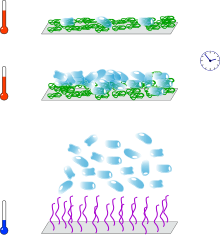 Adhesion of cells on a surface coated with a thermo responsive polymer. Displayed is a polymer with LCST.
Thermoresponsivity in Organic Solvents:
Due to the low entropy of mixing miscibility gaps are often observed for polymer solutions. Many polymers are known that show UCST or LCST behavior in organic solvents. Examples for organic polymer solutions with UCST are polystyrene in cyclohexane, polyethylene in diphenylether or polymethylmethacrylate in acetonitrile.
Thermoresponsivity in Water:
Polymer solutions that show thermo responsivity in water are especially important since water as a solvent is cheap, safe and biologically relevant. Current research efforts focus on water-based applications like drug delivery systems, tissue engineering, bioseperation.
http://en.wikipedia.org/wiki/Temperature-responsive_polymers


 However as cars became overpopulated, they have been influencing our environment negatively.
 -Jane Jacobs. The Nature of Economics. Random House. 2000